Prime lenses are lenses without a zoom function. They have a constant focal length, and a constant angle of view. When the Micro Four Thirds system was introduced, the very first prime lenses were the Olympus 17mm f/2.8 and the Lumix G 20mm f/1.7. While the Olympus prime lens was generally disliked for the limited maximum aperture, the Lumix lens was an instant classic with the brighter aperture and the perceived very good optical qualities.
Since that time, a lot of prime lenses for the M4/3 system have been introduced. In this article, I present an overview of these lenses.
First, here is an illustration which presents the lenses in terms of the focal length (the X axis) and the aperture (the Y axis). In the picture, the lenses are plotted as dots, where the size illustrate their relative price, and the colour the brand:
In the rest of the article, I illustrate what the focal length and aperture means, before going into details about the individual lenses.
BCN Ranking provides monthly sales statistics for various items in Japan. One of them is system cameras, which includes DSLRs and mirrorless systems.
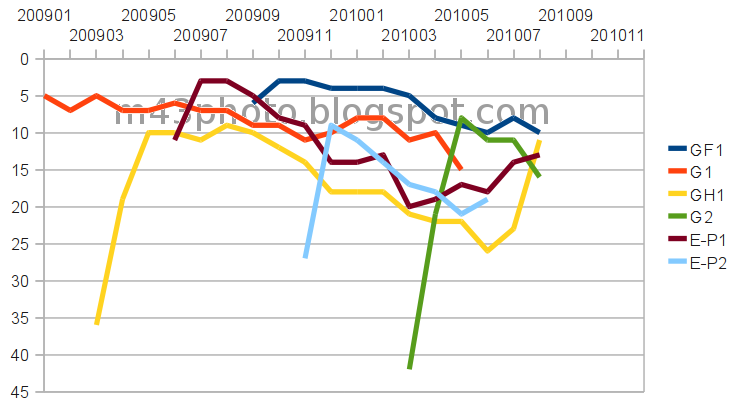
Here is the most recent sales statistics for Micro Four Thirds camera systems. The number in the graph is the ranking the given month. So a "4" means that the specific model was the fourth most sold model during that month. In the first two places you typically find the basic kit models from Nikon and Canon.
There are a lot of interesting findings here. For example, two Panasonic models have had a second birth: Both the GF1 and GH1 have seen an increase of sales, probably due to the discounted prices awaiting the arrival of the newer models GF2 and GH2. This also applies to the Olympus E-P1 camera, which saw a significant sales increase in the third quarter of 2010.
Another finding is that while the Panasonic Lumix G1 sold pretty stably, it was the Olympus E-P1 which made a big difference in the Japanese market. This is consistent with what I saw in the Nordic market. Even though the G1 has, in my opinion, better photographic functionality, it was the E-P1, with the retro styling, and somewhat slimmer body, which got the landslide sales. The E-P2 never was a big seller, it seems.
In the mean time, some competitors have also launched systems. I was not able to find statistics for the Samsung NX system, but the Sony NEX was easy to find. In the diagram below, it is apparent that the Sony NEX was a big hit in Japan.
The top model Sony NEX 5 got an impressive second place in June 2010, and retained the third place in July and August.
For Photokina 2010, Lensbaby introduced their newest product: The Tilt Transformer. It can be had for Micro Four Thirds cameras, and for Sony NEX E-mount. It can be bought stand alone, or with a Composer lens element.
Below are both products: The Composer (left) and the Tilt Transformer (right):
The Tilt Transformer (right) can be mounted to a Micro Four Thirds camera. This device acts as an adapter for Nikon F lenses, and also as a tilting platform.
The Composer (left) is a very simple lens. Turning the black ring around the lens pushes the lens elements back and forth, thus giving manual focus capability. To change the aperture, you need to disassemble the lens, and change the aperture plate. The lens comes with round plates with curcular holes, corresponding to apertures from f/1.8 to f/22.
One would perhaps think that the Composer can also be used as a lens on Nikon cameras, since the Tilt Transformer accepts Nikon lenses. However, this does not appear to be true. It is probably not a good idea to try to mount the Composer to a Nikon camera, since the lens element protrudes far into the camera, possibly interfering with the mirror.
The next picture shows the two devices mounted together:
In this configuration, it acts as a standalone lens for Micro Four Thirds cameras, with tilt capability built in. Loosening the ribbed metal ring allows you to rotate and tilt the adapter and Composer lens element. You can tighten the ring to fix the rotation and tilt in place.
Build quality
Unlike most native Micro Four Thirds lenses, the chassis of this lens is composed largely of metal. Still, it does not have a very good quality feeling: For example, the finish of extruded parts is somewhat rough. Also, what annoyed me, was that when mounted on a camera, the connection is a bit loose. Even the cheapest adapters fit the camera well, in my experience, but when mounting the Tilt Transformer on the camera, there is some play in the connection. It can be jerked a bit back and forth, unlike any other lenses I have tried on a Micro Four Thirds camera.
In use
When loosening the ribbed metal ring, you can adjust the amount of tilt. This adjustment is not dampened well. The tilting adapter moves quite jerkily. Again, I think this is a bit disappointing. Tightening the locking ring fixes the position of the adapter, and this functions well.
Manual focusing is pretty easy. The focus ring is very light to operate, and there is a lot of rotation, meaning that fine tuning is easy.
Changing the aperture is, of course, a bit of a hassle. You must unscrew the front section of the lens, remove the aperture disc with the supplied magnet tool, and then insert a new disc with the aperture of your choice, before putting back the front lens section.
Example image
This is the very first image I took using this adapter/lens combination. I used the f/4 aperture plate, and tilted the lens a bit to the side. Then I rotated the focus ring so that the middle part of the image was in focus, and pushed the shutter release. That's it. The picture was taken with a Panasonic Lumix GH1. (Click for a larger image.)
So is this image interesting? Well, it does have a "miniature" look to it, due to the selective focus. With some practice, the effect can be made much better.
One of the fun things with the Micro Four Thirds (MFT) format, is the short flange distance (20mm), which enables the possibility of making adapters for a number of formats. There are cheap, abundant adapters for many legacy formats, e.g., Nikon F and Pentax K, to name a few.
When MFT becomes legacy
However, the flip side of the coin is that some day, inevitably, MFT is also going to become a legacy format. What happens with your gorgeous, and expensive, MFT lenses then?
Let's say that the worst case scenario is that, due to competition, the MFT system loses so much volume that it is abandoned by Olympus and Panasonic. It doesn't seem likely now, but stranger things have happened.
You can still use your old cameras and lenses, of course, but at some point you will want a newer camera, due to new features and better image quality. Can you still use your MFT lenses on some camera from another system?
If Samsung NX becomes dominating
The Samsung NX format is one of the competitors in the mirrorless system category. Let's say this format becomes dominating. Can you use your old MFT lenses on this format through an adapter?
In short: No. It's not possible. The Samsung NX format has a longer flange distance (25.50mm), meaning that even if you made a very short adapter, the MFT lenses would not be able to focus to infinity. You could only use them as short focus macro lenses. Which is not very useful.
If Sony E becomes dominating
The Sony E format was introduced for their new NEX series. It has a flange distance which is 2mm shorter than the MFT format. This is good news, because 2mm, while pretty short, is probably enough to make an adapter for using MFT lenses on Sony E. The Sony E format also has a wider flange diameter, which makes it easier to design an adapter.
However, the MFT lenses are pretty useless without the possibility to operate the focus and the aperture. And both are operated electronically, controlled by the camera. So an adapter must have the relevant software to interpret the Sony E signals, and translate them into something that the MFT lenses understand.
This kind of electronic communication might sound easy, however, it is probably far from trivial. And at best, your autofocus would probably be very poor, both the speed, and, possibly, also the accuracy.
For a comparison, let's consider the Canon EF system. There are adapters for using Canon EF lenses on MFT cameras, but none of them can control the aperture or the focus. So the probability of getting future adapters that provide this feature for MFT lenses seems pretty slim, given that there are many magnitudes more Canon EF lenses out there than MFT lenses.
Conclusion
The conclusion is that if the MFT system is abandoned, your lenses are more or less useless.
On the other hand, there are some rumors now that the modular Ricoh GXR system will include a Micro Four Thirds mount/sensor module. If launched, this will enable mounting a MFT lens to the Ricoh GXR camera, with an adapter mount/sensor module.
Update December 2010
Since I wrote this article, an adapter for using MFT lenses on Sony E cameras (NEX) has actually emerged. However, since it has no electronic contact, it can not control neither the focus nor the aperture. So you're stuck with a focus around infinity, and the max aperture. You can, however, use it with the Cosina Nokton 25mm f/0.95, which is a completely manual lens, with a mechanical focus ring, and a mechanical aperture ring.
The Panasonic Lumix 20mm f/1.7 pancake is a brilliant lens, but it does not come with a lens hood. Flare is not a big issue with this lens, but a lens hood is still good for protecting the front element. Some people use UV protection filters for the same effect, however, adding another glass layer will reduce the image quality to some degree.
One option is to get a cheap third party hood designed for the Leica Summilux lens, to screw into the front 46mm filter thread. However, this hood adds some bulk to the lens, making it less compact. The compactness is one of the desirable features of the Lumix 20mm pancake in the first place.
In an attempt to find a low profile hood that looks more like the hood for the Pentax 40mm f/2.8 pancake lens, I bought a cheap 46mm to 37mm step down ring. The ring is essentially a short cylinder with 46mm threads on the outside, and 37mm threads on the inside.
The ring is made out of light metal, and is extruded on the rear side to save some weight:
Step up and step down rings should be used with care with the Lumix 20mm pancake. When powering down, the lens retracts the front assembly slightly into the chassis, which will jam and possibly damage the focus mechanism if you attach a ring which is too wide. The following picture shows that this step down ring is not too wide, and can be safely used with the Lumix 20mm pancake lens:
Looking at hoods, you will note that they are usually ribbed and matte on the inside. This is to avoid having light reflected into the lens. Since the inside of the step down ring is threaded, it already has the right shape. However, the metal is still a bit shiny. To make it more matte, I applied some matte black enamel paint on the inside threads. Wanting to retain the stealthy look of the lens, I also painted the front and the side of the ring:
Here is the lens with the "home made" hood attached. This hood does not cause any additional vignetting.
You will probably want to have a front lens cap as well, and you can get a 37mm cap which fits into the front threads of the step down ring. Both the step down ring and the front lens cap can be found on various auction sites.
Panasonic Lumix Micro Four Thirds (MFT) cameras can use all Four Thirds (FT) lenses, provided that you use an adapter. You can use either the Panasonic DMW-MA1, or Olympus MMF1/MMF2 adapters.
However, you should note that not all FT lenses will autofocus on Panasonic MFT cameras. Only fairly recent lens designs that are prepared for contrast detection auto focus (CDAF), will work. The compatible FT lenses are
These lenses will autofocus on Panasonic Lumix MFT cameras, like G1, GH1 and GF1.
Newer Panasonic cameras like GH2, G2 and G10 feature some improved autofocus functionality using some FT lenses. For example, the GH2 can autofocus using the Olympus 50mm Four Thirds lens, but the focus is very slow. The Panasonic G1, GH1 and GF1 will not autofocus this lens at all.
All Olympus MFT cameras can autofocus with all FT lenses, so Olympus camera users can ignore this list. This also goes for Panasonic FT lenses used on Olympus MFT cameras. The autofocus can be very slow with some FT lenses, though.
This ring is an adapter for using Pentax K lenses on a Four Thirds mount. It is a crude adapter ring, with no aperture stop down functionality, and no electrical contacts. The adapter adds 7mm of spacing. The packet reads "Olympus 4/3-PK". The adapter can be bought for around US$15 on various auction sites.
Naturally, this adapter is made for use with a Four Thirds mount, so it cannot be put directly on a Micro Four Thirds camera. You will need another adapter stacked between them. I used the Panasonic DMW-MA1 Four Thirds to Micro Four Thirds adapter, but the Olympus MMF1 would have done the same job, since they are functionally similar.
Here are both adapters laid out, with the Pentax 50mm f/1.4 lens behind them.
When stacked together, the adapters allow for mounting Pentax K lenses to a Micro Four Thirds camera. You can see this done in the picture below, with the Pentax 50mm f/1.4 mounted to a Panasonic Lumix GH1.
Note that Pentax K lenses with an aperture ring are most suited for this use. If there is no aperture ring on the lens, then it is impossible to use an aperture smaller than the max, which is f/1.4 in this case. That makes the lens difficult to use. Focusing must be done manually, of course.
There are also adapters for Pentax K lenses to be mounted directly on Micro Four Thirds cameras. They tend to be somewhat more expensive, since they are larger, and also because they were introduced more recently.
The two legacy adapters I have explored so far, Nikon F and Pentax K, represent merely scratching the surface. There are adapters that can be used to mount a wide variety of lenses to Micro Four Thirds cameras. From high end Leica M lenses, to crude surveillance camera lenses.
One of the benefits of the Micro Four Thirds format is the short register distance. Since virtually all other formats have a longer register distance, it is possible to make adapters for other lenses to be used on Micro Four Thirds.
It reads "NIK-M4/3", and can be used to mount Nikon F mount lenses to a Micro Four Thirds camera. These kind of adapters are simple, meaning that they only provide a means to mount the lens, and no control over the aperture or focus is possible from the camera. On the positive side, they are rather inexpensive, and can be purchased for around US$30-40.
When using a third party adapter like this, the camera has no electronic confirmation that a lens is actually connected. For the camera to still operate, you need to set the menu item "shoot without lens". This is found under the "Custom" menu, indicated by a "C" with a wrench icon. Here is the menu item from the GH2 camera:
In the picture below, the adapter is used to mount a Nikkor 200mm f/4 AIS tele lens to the Panasonic Lumix GH1. When using this legacy lens on a Four Thirds camera, the field of view becomes equivalent to a 400mm lens. With a long tele like this, using a tripod is a necessity. While you can choose fast shutter speeds and capture an image without blurring due to camera shake, framing the subject is very difficult when handholding this combination. Recording video without a tripod is virtually impossible with such a long lens.
This lens has an aperture ring. Since the camera cannot control the aperture, it needs to be set manually. The presence of an aperture ring makes this operation easier. Some more expensive adapters have a means for controlling the aperture also for lenses without the aperture ring, e.g., the Nikon G mount lenses.
Many newer lenses do not have aperture rings, and require an adapters with a lever to stop the lens down. This goes for both Nikon and Pentax lenses.
Focus confirmation
There is some talk on the internet about adapters that provide focus confirmation for legacy lenses. To my knowledge, such a thing is not possible with Micro Four Thirds cameras. The cameras cannot confirm the focus when using non-compatible lenses. In fact, with the current cameras, the only way for the camera to know that the image is in focus, is to use a Micro Four Thirds lens, or one of the CDAF compatible Four Thirds lenses.
To be able to confirm the focus, the camera must jog the focus back and forth to find the optimum contrast. This is not possible with manual focus lenses, of course, since the camera cannot control the focus at all. So focus confirm adapters for Micro Four Thirds simply make no sense at all.
The Four Thirds systems is a DSLR camera system originally developed by Olympus and Kodak. The first Olympus camera was announced in 2003 (the professional grade Olympus E-1), along with four lenses.
While the major players in the DSLR camera market based their digital cameras on their existing film camera mounts and lenses, Olympus did not have a significant user base at this time, and found it better to design a new system from ground up, based on the requirements of digital photography.
Aspect ratio and sensor size
The name "Four Thirds" cleverly refers to two things at the same time:
The image aspect ratio. While the aspect ratio of 35mm film cameras is 3:2, the Four Thirds system has a more square aspect ratio of 4:3. There are many reasons for this, e.g., a typical print size is 8:10, with a more similar aspect ratio to 4:3. And professional medium formats are typically closer to square aspects, like 4.5x6, 6x6 and 6x7. However, since the introduction of Four Thirds, formats that are even wider than 3:2 have become popular. TV sets are now typically 16:9. I still think that 4:3 makes sense for photography. A more square format uses the image circle more efficiently, which is an advantage, assuming, of course, that you're not going to crop it down to a more rectangular format.
The size of the sensor. The sensor has the same size as the imageing area of a 4/3'' diameter legacy cathode ray tube for video cameras. The actual size of the sensor is still significantly smaller than 4/3'', with the diagonal of the imaging area usually being 21.6 mm.
The Four Thirds sensor size is about 30-40% smaller than the APS-C sensors commonly used in other DSLR systems. This has various consequences:
In theory, a smaller sensor usually means worse high ISO capabilities, and worse dynamic range characteristics, given the same number of pixels, and the same sensor technology.
The depth of field is larger with a smaller sensor. This means that given the same distance, field of view and aperture, more will be in focus with a smaller sensor. This is both an advantage and a disadvantage. In landscape photography, you will most often want sharpness across the image, and a wide depth of field. On the other hand, in portrait photography, it is often desireable to have a narrow depth of field, to achieve isolation of the subject, and blurring of the background.
A smaller sensor will limit the useful range of apertures more, due to diffraction, again assuming the same number of pixels. Diffraction will make the image blurry at pixel level when using small apertures. This is not due to bad design, but rather the result of the laws of nature.
Designing lenses and cameras around smaller sensors is in some ways easier: They can be made more compact.
A small sensor gives a higher crop factor. The crop factor of the Four Thirds sensor is roughly 2x, meaning that the focal length in mm for a Four Thirds lens must be multiplied with 2 to get the equivalent focal length on a traditional 35mm camera. Hence, a 14mm lens on Four Thirds is a wide angle lens, corresponding to 28mm on a traditional film camera. Some suggest that with this background, systems with a high crop factor are good for people who need long lenses, e.g., for wildlife photography. However, there are lenses to suit virtually all needs in the Four Thirds system.
Lens design
Another important aspect of the Four Thirds mount is the register distance, also called the flange focal distance. The register distance is the distance between the lens mount and the sensor plane. With the sensor size being smaller than for other DSLR systems, the Four Thirds system also has a smaller register distance. This aspect of the camera systems makes designing lenses, especially wide angle lenses, easier.
Olympus lenses are commonly more telecentric than lenses from other systems, especially lenses that were originally designed for film. The telecentric property of a lens means that the light rays coming from the lens hit the sensor at a more normal angle across the field, especially in the corners. This is important for digital photography, since the sensors are sensitive to the angle of the light rays: If the light rays are hitting the sensor at a narrower angle in the corners, a significant portion of the light will be lost in the sensor pixel bins, giving heavy vignetting. More telecentric lenses generally give less vignetting in the corners. However, designing telecentric lenses is more complicated, and some of the size advantage of the smaller sensor is lost with this property of the lenses.
History
The original cameras in the Four Thirds system were not so compact, and, while they were innovative, they were also somewhat strange looking. Later, Olympus launched smaller cameras, with the E-4xx series being the smallest DSLRs on the market at the time of availability. The cameras have also been more traditional looking after the first two-three years. After some years of maturing, the Olympus DSLRs are not very different from the competitors, beyond being somewhat smaller.
Panasonic and Leica have also issued cameras in the Four Thirds system, however with major components Olympus sourced. The Leica branded cameras have largely been similar to Panasonic models, with smaller changes to the design and software. Since this time, both Panasonic and Leica appear to have withdrawn from the Four Thirds system, with Panasonic focusing more on the newer and more compact Micro Four Thirds system, and Leica designing their own high end cameras, e.g., the Leica X1. Leica still appears to have some involvement in the design of lenses for the Micro Four Thirds system, with the Leica branded 45mm f/2.8 macro lens launched in the autumn 2009.
A new standard was announced in 2008, the Micro Four Thirds. This shares the sensor size with Four Thirds, however, leaving no room for a mirror assembly. Panasonic G1, the first camera for this standard, was launched in the autumn 2008. The new system has been very successful in Japan, and Panasonic cameras and lenses have been scarce in Europe and especially the US in 2009, suggesting a high demand.
According to the statistics quoted above, the Olympus E-P1 Micro Four Thirds camera was the most selling Olympus camera model in Japan 2009. This has prompted some concern that Olympus might discontinue the regular Four Thirds line, and focus exclusively on Micro Four Thirds. I think the chances for this are slim at the moment, since Olympus has a large and good back catalogue of Four Thirds lenses. While the E-P1 camera has sold a lot, I am sure that they have sold a lot of Four Thirds lenses as well, not recorded by the statistics.
This is an unusual lens. Not only is it a macro lens capable of photographing subjects as small as 2x the sensor size (hence the 1:2 designation), but it is also a fast short tele suitable for portraits, with a maximum aperture of f/2. The focal length is 50mm, however, with the 2x crop factor associated with Four Thirds, it will have the same field of view as a 100mm lens on a traditional 35mm camera.
Since this is a Four Thirds standard lens, it cannot be used on a Micro Four Thirds camera without an adapter. It is shown here with the Panasonic DMW-MA1 adapter attached. The Olympus MMF1/MMF2 adapter would have done the same job, as it is functionally the same, albeit usually somewhat more expensive at retail.
Focus
Unfortunately, you cannot use autofocus with this lens together with the first series of Panasonic Micro Four Thirds camera bodies (G1, GH1, GF1). The Olympus cameras, and newer Panasonic cameras, on the other hand, can do autofocus with this lens, albeit operating at a slow speed. Here is a demonstration of the autofocus using Panasonic GH2, which takes five seconds to focus down to 45 cm distance:
The closest focus distance is 0.23 m. Be aware, though, that the focus distance is measured from the focal plane (the sensor), and so the distance between the front lens and the subject at closest focus is about 0.1 m.
The lens is also special in that it is one of the few Four Thirds lenses that feature a focus scale.
Size
Compared with the Lumix G 20mm pancake lens, the Olympus 50mm macro, including adapter and hood, is enormous. However, it is of course more natural to compare it with other 100mm equivalent macro lenses, in which case it is remarkably compact.
Most macro lenses have a maximum aperture of f/2.8 or slower, e.g., Sigma 105mm f/2.8 and Tamron 90mm f/2.8, both in the same focal length range. Hence, a f/2 macro lens is unusual, and some might say this speed is not needed. You would rarely photograph small subjects with such a large aperture, since the depth of field (DOF) becomes very narrow. Unless the subject is more or less flat, only a small part of it will be in focus at f/2. Stopping down to at least f/5.6 may be needed to have a sensible depth of field at close focus.
Here is a series of photos that illustrate the depth of field at 25cm distance, and various aperture sizes. The focus is set to the centre face. The distance in the axis of the lens between the three heads is one LEGO unit, or 8mm, if your not familiar with this measure. You must stop down to f/16 to get a depth of field that covers this distance.
At such a small aperture as f/16, you are going to see some lack of sharpness at the pixel level due to diffraction. You may still choose a small aperture like this, however, if you need a wide depth of field, and can live with some dullness at pixel level. For web use, for example, where you will normally scale down the image, this should not be any problem.
In macro photography, it is uncommon to use autofocus, since you will need to fine tune the focus anyway to get the desired effect. So the lack of autofocus on Panasonic Micro Four Thirds cameras is not a problem for macro photography.
Bokeh
I've made a study of the bokeh of the lens. My conclusion is that the bokeh is very pleasing, although the out of focus highlights have a somewhat hard edge. But in general, you're unlikely to be dissatisfied with the bokeh using this lens.
Portrait lens
When taking headshots, it is common to keep some distance to the subject. This is done to avoid perspective distortion. Taking a picture of someones face from a short distance will usually give unwanted distortions, e.g., showing an unnaturally large nose or a large chin. Traditionally, an 85mm lens has been used on a 35mm camera to be able to fill the head and shoulders of a person in a picture frame, and still keep enough distance to the person to avoid perspective distortion. The Olympus 50mm macro lens corresponds to 100mm focal length on a 35mm camera, and so it is useful for portraits.
A traditional portrait lens will be around 85mm f/1.4. The Olympus 50mm macro has one stop slower aperture at f/2, but it is still large enough to isolate the background when taking portraits.
In studio photography, the lack of autofocus is not likely to be a problem. If you're photographing people in a more dynamic environment, you may see the need for autofocus.
Other uses
You could also use this lens for concert photography, given that you're placed not too close to the stage, and the people on the stage are not moving around too much. If you've got something to rest the lens against, you may be able to use longer shutter speeds.
Sharpness
This lens is generally considered to be among the best in the Olympus Four Thirds lineup. It is remarkably sharp from f/2, but close it down a bit for even better sharpness. At f/5.6 it is probably around the sharpest.
Chromatic aberrations
I have made a study of the chromatic aberration (CA) artifacts of this lens, and some other prime lenses. It shows that there are quite some red/green fringing artifacts even in the centre of the image. You will note this if you photograph high contrast images.
Image stabilization
Using this lens with a Panasonic Micro Four Thirds camera, there is no image stabilization available at all. You'll normally want to use a fairly short shutter speed, e.g., 1/60 second or faster, to avoid camera shake affecting the image when handholding the camera.
Olympus Micro Four Thirds cameras have image stabilization built into the bodies, which will work with this lens.
It is perfectly possible to use this lens when recording videos. However, you can only focus manually on Panasonic cameras. With the lack of image stabilization, and a pretty long focal length, it is more or less impossible to handhold the camera stably while recording movies. Using the electronic viewfinder and pressing the camera against your face may help you to stabilize it a bit. But using a tripod is preferred when filming with this lens.
Hood
The lens comes with a bayonet hood, to protect against stray light. I found the hood to be a tad bit long, making it difficult to fit the camera with lens and hood inside my small camera bag, so I chose to use a 52mm screw-in hood from B+W. The hood also protects the front lens element from objects touching it accidentally.
Example picture
Here is an example picture of a broken Leatherman tool taken at maximum magnification (closest focus distance), f/10, 1/5 s, ISO 100.
Other macro options
It is also possible to achieve macro close up photos by using macro extension rings.
The Japan market shares are usually published every year. The figures comprise system camera units sold in Japan, mostly DSLRs, but the new Micro Four Thirds cameras are included as well. Only the 20 camera models with the largest sold volumes are included in the statistics. Other camera models, with less sales than these, are in the "Others" category.
I have concatenated the 2009 statistics (as at Dec 23rd) with the 2008 statistics, to be able to see the development better:
To make it easier to digest, I have split the figures into camera systems:
Before starting to comment on these figures, it is useful to note that the "Others" category is larger in 2009. This means that the volume of the smallest camera models has increased. We don't know how large the volume of various camera systems are here, but it is reasonable to guess that we would find some more Olympus, Sony and Nikon models in the 2009 "Others" category.
Canon has held their market share remarkably well. It is also worth noting that the full frame camera Canon 5D Mark II has a fairly high market share at 2.1%.
Nikon appears to have lost significant market shares, which must be very bad news for them. On the other hand, it is reasonable to guess that they have somewhat more volume in the "Others" category in 2009, with, e.g., the Nikon D300 and Nikon D700.
Sony must also be very disappointed, with less than 50% of the 2008 market shares. Again, though, they probably have more camera models in "Others" in 2009.
Pentax have succeeded with their strategy of launching entry models packed with features.
Olympus have only got one Four Thirds model in the 2009 list of the twenty most sold camera models, compared with three in the 2008 list. On the other hand, the E-P1 camera has been very popular, and made up for the lost Four Thirds units.
The Micro Four Thirds system has a total of 11.5% of the new sales in Japan in 2009, which I think is very remarkable. After all, the system was launched in 2008, and only two small players in the system camera market are behind it.
2007
For the fiscal year 2007 (actually only January through November), I could only find DSLR sales in summary form: Nikon 43.3%, Canon 39.9% and Pentax 6.3%, with the other producers being smaller.
2006
This table contains DSLR market shares in Japan by December 2006, for the largest ten camera models. I find it hard to believe that the D40 has already captured 15.5% of the total market in December 2006, since it was introduced the same month. However, this table might have been adjusted for the introduction time of each model.
Summary 2006-2009
All of this information can be summarized into one table, but please be aware that the numbers are not entirely comparable from year to year. Still, there is a trend to be seen.
2005-2009 from another source
BCNranking has published statistics for the three most sold brands within interchangeable lens cameras, meaning DSLRs and hybrid systems like Micro Four Thirds. This table shows the same trend as the other material:
We can see that while Canon has had a stable marked share the most recent years, they have actually had a significant decline when looking back five years. Also, Nikon had a good period around 2007, probably due to the launch of D40, but has not been able to sustain the growth.
Panasonic is the big surprise in 2009, with a third place due to the Micro Four Thirds bodies, probably mostly the G1, having been on the market for the whole 2009.
The Panasonic Lumix G 20mm f/1.7 pancake lens was launched in the autumn 2009, and became an instant classic even before it was widely available.
It is interesting that Nikon has launched a lens with basically the same properties for Nikon Z: Nikon Z 40mm f/2. As this lens is a full format lens, it has the same field of view as a 20mm lens on Micro Four Thirds.
Most people who had a Micro Four Thirds camera by this time probably already owned a kit lens which covers the 20mm focal length, e.g., the Lumix 14-140mm, Lumix 14-45mm, or Olympus 14-42mm. So why add another lens in the same range?
There are several reasons why a lot of people like this lens. The focal length corresponds to 40mm on an old style 35mm film based camera, which can be considered as a slightly wide normal focal length. While there is nothing magical about this "normal" focal length, it is considered to give images that look normal to a human observer, in terms of perspective. It sits between wide angle and tele lenses, and while different photographers have different tastes, it remains a useful focal length for a lot of situations.
I have made some tests of the autofocus speed of the Panasonic Lumix GH1 camera with various lenses. The camera focused from infinity (the default position of the lens when powering down) to near the minimum focus distance, and I used a LEGO figure as the subject.
The test was done in indoor lightning, about EV6. The focus time is measured as the time from my finger presses the shutter button until the green focus confirmation light comes up in the display. The picture is taken immediately after focus is achieved, within one tenth of a second.
You will hear the shutter operating twice, since the camera was in multi exposure mode. I did confirm that all the images were indeed in focus, as is expected with a contrast detection autofocus system (CDAF).
Summary
Before going into the details, here is a quick summary
Lumix G 20mm
1.23 seconds
Lumix G HD 14-140 @ 18mm
0.53 seconds
Lumix G HD 14-140 @ 50mm
0.40 seconds
Lumix G HD 14-140 @ 140mm
1.63 seconds
Lumix G 45-200 @ 45mm
0.33 seconds
Lumix G 45-200 @ 100mm
0.36 seconds
Lumix G 45-200 @ 200mm
0.87 seconds
Olympus 4/3 9-18 @ 9mm
2.90 seconds
Olympus 4/3 9-18 @ 18mm
1.50 seconds
What is a bit surprising here, is that the 45-200mm lens is quicker than the HD 14-140mm. The latter is marketed as a very quick focusing lens, optimized for video, hence the HD designation. However, the 45-200mm lens has an advantage, since it's close focusing distance is 100cm, twice that of the HD 14-140mm. So when focusing from infinity to the minimum focusing distance, the HD 14-140mm has a longer way to travel.
Focal length 18mm (36mm in 35mm camera equivalent), f/4.3:
Autofocus from infinity to 53cm: 0.53 seconds.
The minimum focus distance of the lens is 50cm.
Focal length 50mm (100mm in 35mm camera equivalent), f/5.6:
Autofocus from infinity to 53cm: 0.40 seconds.
The minimum focus distance of the lens is 50cm.
Focal length 140mm (280mm in 35mm camera equivalent), f/5.8:
Autofocus from infinity to 53cm: 1.63 seconds.
The minimum focus distance of the lens is 50cm.
The outcome for f=140mm deserves some more comments. As you can see from the video, the focus is hunting a bit before settling. I tried to redo this experiment several times, and found that the outcomes were very consistent. My speculation is that I have been operating close to the minimum focus distance, and that perhaps this distance is slightly longer in the tele setting. Indeed, moving the subject a bit further away from the camera gave focus speed consistent with 18mm and 50mm focal lengths.
Focal length 45mm (90mm in 35mm camera equivalent), f/4.0:
Autofocus from infinity to 1m: 0.33 seconds.
Focal length 100mm (200mm in 35mm camera equivalent), f/4.6:
Autofocus from infinity to 1m: 0.36 seconds.
Focal length 200mm (400mm in 35mm camera equivalent), f/5.6:
Autofocus from infinity to 1m: 0.87 seconds.
Lens: Olympus Zuiko Digital ED 9-18mm f/4-5.6
Note that this is not a Micro Four Thirds standard lens, but rather a lens for the Four Thirds DSLR system. To mount this lens on a Micro Four Thirds camera, you will need and adapter. I used with the adapter Panasonic DMW-MA1, but the Olympus MMF-1 adapter is functionally the same, and would have done the same job.
Not all Four Thirds lenses can autofocus on Panasonic Micro Four Thirds bodies, like the GH1. Here is a list.
Focal length 9mm (18mm in 35mm camera equivalent), f/4:
Autofocus from infinity to 25cm: 2.90 seconds.
The minimum focus distance of the lens is 25cm.
Focal length 18mm (36mm in 35mm camera equivalent), f/5.6:
Autofocus from infinity to 25cm: 1.50 seconds.
The minimum focus distance of the lens is 25cm.
Conclusions
The autofocus speed of the Lumix G HD 14-140mm lens is the fastest in this comparison, which is as expected. The unexpected result in this context was the significantly slower autofocus speed at full tele, 140mm, however there is reason to believe that this was related to operating close to the minimum focus distance, as discussed above.
Just as with the superzoom above, the Lumix G 45-200mm features very impressive autofocus speed. The exception is at full tele, however, the speed at 200mm is still very good. The autofocus is virtually inaudible.
The Lumix G 20mm lens does indeed focus slower than the HD lens, and also somewhat more audibly.
Using autofocus with the Olympus 9-18mm Four Thirds lens is possible, but pretty slow. Especially at the wide angle setting. Focusing with this lens is also quite noisy. Taking pictures of moving subjects, e.g., children, with this lens could pose some difficulty with autofocus. In this case, it could be wise to prefocus, and set the camera to manual focus (MF) while composing the image. That way, you can take the picture nearly instantly when pressing the shutter, rather than having to wait some seconds for the autofocus to settle.
Lumix G 20mm
1.23 seconds
Lumix G HD 14-140 @ 18mm
0.53 seconds
Lumix G HD 14-140 @ 50mm
0.40 seconds
Lumix G HD 14-140 @ 140mm
1.63 seconds
Lumix G 45-200 @ 45mm
0.33 seconds
Lumix G 45-200 @ 100mm
0.36 seconds
Lumix G 45-200 @ 200mm
0.87 seconds
Olympus 4/3 9-18 @ 9mm
2.90 seconds
Olympus 4/3 9-18 @ 18mm
1.50 seconds
Mostly, you will not focus down to near the minimum focus limit of the lens, and so autofocus will usually be faster than these examples. The Olympus 9-18mm lens is a bit of an exception to this, however, as even focusing on a distant subject takes virtually as long time as focusing close.
Rumors say that future Panasonic models, like Lumix G2 and Lumix G10, will focus faster with Four Thirds lenses on an adapter.
It is only natural that the Panasonic Lumix 14-140mm zoom lens is associated with the Panasonic Lumix GH1 camera: They were both only available as a kit for the first months following the launch in spring 2009. It was only after some time that the lens could be bought alone. From January 2010, the GH1 can be purchased as body only in the UK.
The lens has a 10x zoom ratio, and falls into the superzoom category. As is common for lenses of this type, it has a wide angle 28mm starting point (in 35mm camera equivalent terms), and goes all the way up to 280mm, which can be considered as a long telephoto lens.
This long zoom range comes at the cost of an aperture range which is not as impressive: f/4 at the wide angle, and f/5.8 at the long end.
One of the benefits of the Micro Four Thirds system is the compact size, and this benefit seems to be negated by the size of this lens. Even attaching it to the Panasonic GF1, the smallest M43 camera at the time of writing, gives a rather large and bulky package.
Since writing this, the lens has been superseded by the Lumix G HD 14-140mm f/3.5-5.6, which is smaller, lighter, and better in almost any way. I would certainly recommend that you consider the newer lens over the old one.
Aperture range
When looking at the aperture range of zoom lenses, it is common to observe the apertures of the end points. The aperture range, however, is far from linear. It increases faster than you might expect. The diagram below illustrates the aperture at various focal lengths (at 35mm camera equivalent) for the Lumix 14-140mm (blue) and the Nikon 18-200mm (red). As you can see, the Lumix lens has the smallest aperture range of the two, which we already knew, but in addition, the aperture closes down faster as the focal range increases, compared with the Nikon lens. The 14-140mm lens has been criticized of being overly expensive, compared with similar lenses on the market. For example, the AF-S Zoom-Nikkor ED 18-200mm f/3.5-5.6G IF DX VR, with an 11% longer zoom range, half a stop larger aperture in the wide end, and is less expensive. Canon has also got a lens with the same specifications as the Nikon, and at an even more attractive price point.
Some answers to these comments have been that the 14-140mm has some unique features not found on other lenses: It is optimized for video recording, and features low noise fast autofocus, and an aperture that can change almost steplessly (at 1/6 stop intervals), and almost inaudibly. The aperture is also marketed as being very precise. Another advantage compared with the Nikon and Canon lenses is that it is more compact, at about 15% shorter at the wide angle setting.
Bokeh
I have compared the bokeh of the lens with the Lumix 20mm f/1.7 pancake lens, with the 45mm f/2.8 macro and the 45-200mm f/4-5.6 zoom lenses and the Lumix 14mm f/2.5 lens. It is fair to say that the bokeh of the 14-140mm superzoom lens is not the best. It is a bit "dirty" and features some ringing. However, with the limited maximum aperture, you're not likely to see much out of focus rendering anyway, so this is not a problem. The 14-140mm zoom lens is also more prone to flare, probably due to the complicated construction featuring 17 lens elements in 13 groups.
Sharpness
When using this lens on the Lumix GH1 camera in auto mode, the camera will almost always choose the largest aperture. The exception is outdoors photography in generous sunshine at wide angle. It is good then, that the lens is pretty sharp from the fastest aperture over most of the zoom range. There is little need to stop down, unless you need a very sharp image.
The images are somewhat soft at full aperture in the telephoto focal lengths, though. However, there is seldom room for stopping down the aperture further when photographing at full tele extension, as the shutter speeds tend to be on the slower side already. If you're using a tripod, and are photographing non-moving subjects, you could benefit from using a somewhat smaller aperture.
The goal of Image Stabilization (IS) is to be able to take images handheld (or on monopod) at a slower shutter speed than otherwise possible. If the image is too dark, the photographer has the options of increasing the ISO sensitivity, using a larger aperture, or using a slower shutter speed. In some cases, it might be impossible, or undesirable, to increase the ISO sensitivity, or to use a larger aperture. If using a slower shutter speed would normally be impossible due to camera shake, IS might be able to save the picture, stabilizing the image as recorded by the sensor.
At higher sensitivity, the image quality is usually worse, and there are limits to how large the aperture can be on a lens. Large aperture lenses are usually bulky and expensive, and even they have a limited aperture. A large aperture can also be more tricky to focus with, since it will give a narrow depth of field, and the image is usually not the sharpest at the largest aperture. These are some examples of reasons why the photographer might prefer to use a slower shutter speed.
Note that while IS can reduce the effect of camera shake on the sharpness of the image, it does not stabilize whatever you are photographing. If you are photographing moving subjects, you will still need a shutter speed fast enough to freeze the movement, if that is what you want.
The concept of Image Stabilization on consumer cameras was first introduced in the nineties. At that time, most cameras were film based, and the only option for a stabilization technique was through the lens. Later, digital cameras have become the most used, and with this invention another technique for stabilizing the image has arisen: Through shifting the sensor. This could not be done in any efficient way with film based cameras, since the film to be exposed is part of a strip which goes through two spools.
Is is no surprise that the camera systems that have been dominating since before the conversion to digital have retained lens based IS, also called Optical Image Stabilization (OIS). Nikon and Canon both had a number of OIS lenses available before digital photography became common. On the other hand, some systems that have been reinvented for digital have employed sensor based IS, for example Olympus (with the Four Thirds System), Konica-Minolta (later Sony) and Pentax. Some systems, predominantly larger format professional systems, offer no image stabilization at all, e.g., Hasselblad and Leica S2. These systems are mostly intended to be used on tripods, hence IS is hardly needed.
Olympus and Panasonic have taken different approaches to IS. Panasonic have chosen to employ image stabilization through the lens (OIS), denoted with their trademarks "Mega O.I.S." or "Power O.I.S.". Olympus, on the other hand, stabilize the image through sensor shift inside the camera body.
There are advantages and disadvantages with both approaches. The camera body sensor shift technique means that any lens attached can be stabilized. The advantages are obvious: You don't need to pay a premium for OIS lenses, and you can use legacy lenses stabilized. The latter point is very interesting, since Micro Four Thirds cameras, with the short register distance, can use a large number of legacy lenses through adapters.
Lens based OIS, on the other hand, has an advantage with long lenses. The longer the lens, the longer the sensor needs to travel sideways to stabilize the image, in the case of in body OIS. For obvious reasons, there are limits to how far the sensor can travel. With lens based stabilization, lens groups inside the lens shift the path of the light, so that the image is always focused on the sensor. This has an added benefit that the image circle of the lens is used more efficiently.
Even if Olympus and Panasonic have chosen different approaches to IS, you can still use Olympus lenses on Panasonic cameras, and the other way around. But you should not use both image stabilization methods at the same time, if you have a camera/lens combination in which this is possible. This will lead to an over-compensation for camera shake, and will give less sharp images.
Personally, I like the idea of sensor shift IS better than lens based OIS. I think that in camera sensor based IS enables you to use a wide variety of lenses with stabilization, including older legacy lenses. Another benefit is that there is no need for additional stabilizing lens groups in the optical path in the lens. This would be more complicated and costly to produce. The more lens elements the light need to pass through, the more potential for degrading the image quality.
In practice, though, we can see now that the Panasonic Lumix G 14-45mm Mega O.I.S. lens is not significantly more expensive than the Olympus M.Zuiko 14-42mm, even though the Panasonic lens features a stabilizer. Also, the Panasonic lens has generally been found to give better image quality, despite the extra lens elements dedicated to stabilization.
Even though my preference is towards camera based stabilization, I still chose to buy the Panasonic Lumix GH1 and GH2, as I felt that it had more features that I liked. For example, I like the high resolution electronic viewfinder, the tiltable LCD display, the better grip, and the more usable autofocus speed. At the time of buying there was the Olympus E-P1 available, with sensor based IS, however, I felt that it could not compete with the GH1 in the areas mentioned above.
This blog is a user's perspective on the Micro Four Thirds camera system. While I intend to keep the contents fact based, there are many areas where no objective truth is available, and hence there is room for different opinions and discussions. I would like to encourage you to contribute with your own experiences or opinions to this blog through the comments fields.
The Micro Four Thirds system was announced jointly by Olympus and Panasonic on August 5th, 2008. The first camera model was launched in November the same year.
Since this time, a number of cameras and lenses have become available for this system. While you can use Micro Four Thirds Olympus lenses with Panasonic cameras and vice versa, they have effectively made two different subsystems due to a different approach to optical image stabilization (OIS): Olympus cameras have images stabilization based on sensor shift inside the body, and no lens based OIS. Panasonic, on the other hand, do not use sensor shift image stabilization at all, but rather employ OIS through some lenses, by having some moving lens groups that are intended to cancel the negative effect of camera shake. These Panasonic lenses are denoted with the trademark "Mega O.I.S.".