Update: There is newer sales data from the end of December 2010 here.
BCN Ranking provides monthly sales statistics for various items in Japan. One of them is system cameras, which includes DSLRs and mirrorless systems.
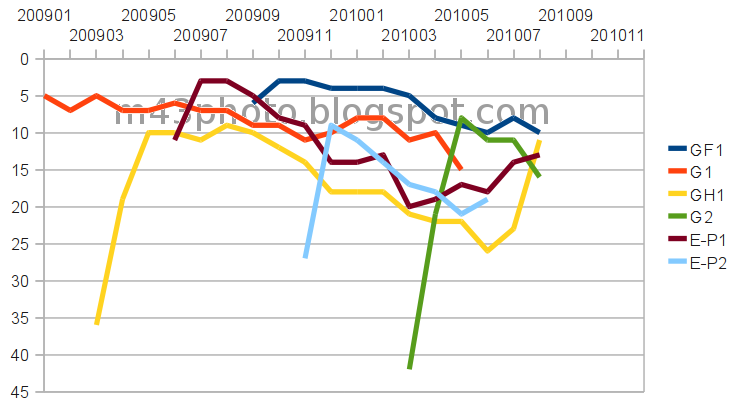
Here is the most recent sales statistics for Micro Four Thirds camera systems. The number in the graph is the ranking the given month. So a "4" means that the specific model was the fourth most sold model during that month. In the first two places you typically find the basic kit models from Nikon and Canon.
There are a lot of interesting findings here. For example, two Panasonic models have had a second birth: Both the GF1 and GH1 have seen an increase of sales, probably due to the discounted prices awaiting the arrival of the newer models GF2 and GH2. This also applies to the Olympus E-P1 camera, which saw a significant sales increase in the third quarter of 2010.
Another finding is that while the Panasonic Lumix G1 sold pretty stably, it was the Olympus E-P1 which made a big difference in the Japanese market. This is consistent with what I saw in the Nordic market. Even though the G1 has, in my opinion, better photographic functionality, it was the E-P1, with the retro styling, and somewhat slimmer body, which got the landslide sales. The E-P2 never was a big seller, it seems.
In the mean time, some competitors have also launched systems. I was not able to find statistics for the Samsung NX system, but the Sony NEX was easy to find. In the diagram below, it is apparent that the Sony NEX was a big hit in Japan.
The top model Sony NEX 5 got an impressive second place in June 2010, and retained the third place in July and August.
Introduction
This blog is a user's perspective on the Micro Four Thirds camera system. Read more ...
Lens Buyer's Guide. Panasonic GH4 review.
My lens reviews: Olympus 9mm f/8 fisheye, Lumix G 12-32mm f/3.5-5.6, Leica 25mm f/1.4, Lumix X 12-35mm f/2.8, Lumix X 35-100mm f/2.8, Sigma 30mm f/2.8, Sigma 19mm f/2.8, Lumix X PZ 14-42mm f/3.5-5.6, Lumix X PZ 45-175mm f/4-5.6, Olympus M.Zuiko 45mm f/1.8, Panasonic Lumix G 100-300mm f/4-5.6, Panasonic Leica Lumix DG Macro-Elmarit 45mm f/2.8 1:1 Macro, Panasonic Lumix G 45-200mm f/4-5.6, Panasonic Lumix G 20mm f/1.7 pancake, Panasonic Lumix G 14mm f/2.5 pancake, Panasonic Lumix G HD 14-140mm f/4-5.8, Panasonic Lumix G HD 14-140mm f/3.5-5.6, Panasonic Lumix G 8mm f/3.5 fisheye, Lumix G 7-14mm f/4, Samyang 7.5mm f/3.5 fisheye, Tokina 300mm f/6.3 mirror reflex tele, Lensbaby 5.8mm f/3.5 circular fisheye lens
The blog contains affiliate links. As an Amazon Associate I earn from qualifying purchases.
Lens Buyer's Guide. Panasonic GH4 review.
My lens reviews: Olympus 9mm f/8 fisheye, Lumix G 12-32mm f/3.5-5.6, Leica 25mm f/1.4, Lumix X 12-35mm f/2.8, Lumix X 35-100mm f/2.8, Sigma 30mm f/2.8, Sigma 19mm f/2.8, Lumix X PZ 14-42mm f/3.5-5.6, Lumix X PZ 45-175mm f/4-5.6, Olympus M.Zuiko 45mm f/1.8, Panasonic Lumix G 100-300mm f/4-5.6, Panasonic Leica Lumix DG Macro-Elmarit 45mm f/2.8 1:1 Macro, Panasonic Lumix G 45-200mm f/4-5.6, Panasonic Lumix G 20mm f/1.7 pancake, Panasonic Lumix G 14mm f/2.5 pancake, Panasonic Lumix G HD 14-140mm f/4-5.8, Panasonic Lumix G HD 14-140mm f/3.5-5.6, Panasonic Lumix G 8mm f/3.5 fisheye, Lumix G 7-14mm f/4, Samyang 7.5mm f/3.5 fisheye, Tokina 300mm f/6.3 mirror reflex tele, Lensbaby 5.8mm f/3.5 circular fisheye lens
The blog contains affiliate links. As an Amazon Associate I earn from qualifying purchases.
Showing posts with label samsung nx. Show all posts
Saturday, 27 November 2010
Saturday, 15 May 2010
Future use of MFT lenses
One of the fun things with the Micro Four Thirds (MFT) format, is the short flange distance (20mm), which enables the possibility of making adapters for a number of formats. There are cheap, abundant adapters for many legacy formats, e.g., Nikon F and Pentax K, to name a few.
When MFT becomes legacy
However, the flip side of the coin is that some day, inevitably, MFT is also going to become a legacy format. What happens with your gorgeous, and expensive, MFT lenses then?
Let's say that the worst case scenario is that, due to competition, the MFT system loses so much volume that it is abandoned by Olympus and Panasonic. It doesn't seem likely now, but stranger things have happened.
You can still use your old cameras and lenses, of course, but at some point you will want a newer camera, due to new features and better image quality. Can you still use your MFT lenses on some camera from another system?
If Samsung NX becomes dominating
The Samsung NX format is one of the competitors in the mirrorless system category. Let's say this format becomes dominating. Can you use your old MFT lenses on this format through an adapter?
In short: No. It's not possible. The Samsung NX format has a longer flange distance (25.50mm), meaning that even if you made a very short adapter, the MFT lenses would not be able to focus to infinity. You could only use them as short focus macro lenses. Which is not very useful.
If Sony E becomes dominating
The Sony E format was introduced for their new NEX series. It has a flange distance which is 2mm shorter than the MFT format. This is good news, because 2mm, while pretty short, is probably enough to make an adapter for using MFT lenses on Sony E. The Sony E format also has a wider flange diameter, which makes it easier to design an adapter.
However, the MFT lenses are pretty useless without the possibility to operate the focus and the aperture. And both are operated electronically, controlled by the camera. So an adapter must have the relevant software to interpret the Sony E signals, and translate them into something that the MFT lenses understand.
This kind of electronic communication might sound easy, however, it is probably far from trivial. And at best, your autofocus would probably be very poor, both the speed, and, possibly, also the accuracy.
For a comparison, let's consider the Canon EF system. There are adapters for using Canon EF lenses on MFT cameras, but none of them can control the aperture or the focus. So the probability of getting future adapters that provide this feature for MFT lenses seems pretty slim, given that there are many magnitudes more Canon EF lenses out there than MFT lenses.
Conclusion
The conclusion is that if the MFT system is abandoned, your lenses are more or less useless.
On the other hand, there are some rumors now that the modular Ricoh GXR system will include a Micro Four Thirds mount/sensor module. If launched, this will enable mounting a MFT lens to the Ricoh GXR camera, with an adapter mount/sensor module.
Update December 2010
Since I wrote this article, an adapter for using MFT lenses on Sony E cameras (NEX) has actually emerged. However, since it has no electronic contact, it can not control neither the focus nor the aperture. So you're stuck with a focus around infinity, and the max aperture. You can, however, use it with the Cosina Nokton 25mm f/0.95, which is a completely manual lens, with a mechanical focus ring, and a mechanical aperture ring.
When MFT becomes legacy
However, the flip side of the coin is that some day, inevitably, MFT is also going to become a legacy format. What happens with your gorgeous, and expensive, MFT lenses then?
Let's say that the worst case scenario is that, due to competition, the MFT system loses so much volume that it is abandoned by Olympus and Panasonic. It doesn't seem likely now, but stranger things have happened.
You can still use your old cameras and lenses, of course, but at some point you will want a newer camera, due to new features and better image quality. Can you still use your MFT lenses on some camera from another system?
If Samsung NX becomes dominating
The Samsung NX format is one of the competitors in the mirrorless system category. Let's say this format becomes dominating. Can you use your old MFT lenses on this format through an adapter?
In short: No. It's not possible. The Samsung NX format has a longer flange distance (25.50mm), meaning that even if you made a very short adapter, the MFT lenses would not be able to focus to infinity. You could only use them as short focus macro lenses. Which is not very useful.
If Sony E becomes dominating
The Sony E format was introduced for their new NEX series. It has a flange distance which is 2mm shorter than the MFT format. This is good news, because 2mm, while pretty short, is probably enough to make an adapter for using MFT lenses on Sony E. The Sony E format also has a wider flange diameter, which makes it easier to design an adapter.
However, the MFT lenses are pretty useless without the possibility to operate the focus and the aperture. And both are operated electronically, controlled by the camera. So an adapter must have the relevant software to interpret the Sony E signals, and translate them into something that the MFT lenses understand.
This kind of electronic communication might sound easy, however, it is probably far from trivial. And at best, your autofocus would probably be very poor, both the speed, and, possibly, also the accuracy.
For a comparison, let's consider the Canon EF system. There are adapters for using Canon EF lenses on MFT cameras, but none of them can control the aperture or the focus. So the probability of getting future adapters that provide this feature for MFT lenses seems pretty slim, given that there are many magnitudes more Canon EF lenses out there than MFT lenses.
Conclusion
The conclusion is that if the MFT system is abandoned, your lenses are more or less useless.
On the other hand, there are some rumors now that the modular Ricoh GXR system will include a Micro Four Thirds mount/sensor module. If launched, this will enable mounting a MFT lens to the Ricoh GXR camera, with an adapter mount/sensor module.
Update December 2010
Since I wrote this article, an adapter for using MFT lenses on Sony E cameras (NEX) has actually emerged. However, since it has no electronic contact, it can not control neither the focus nor the aperture. So you're stuck with a focus around infinity, and the max aperture. You can, however, use it with the Cosina Nokton 25mm f/0.95, which is a completely manual lens, with a mechanical focus ring, and a mechanical aperture ring.
Subscribe to:
Posts (Atom)

