Introduction

This blog is a user's perspective on the Micro Four Thirds camera system. Read more ...

Lens Buyer's Guide. Panasonic GH4 review.

My lens reviews: Olympus 9mm f/8 fisheye, Lumix G 12-32mm f/3.5-5.6, Leica 25mm f/1.4, Lumix X 12-35mm f/2.8, Lumix X 35-100mm f/2.8, Sigma 30mm f/2.8, Sigma 19mm f/2.8, Lumix X PZ 14-42mm f/3.5-5.6, Lumix X PZ 45-175mm f/4-5.6, Olympus M.Zuiko 45mm f/1.8, Panasonic Lumix G 100-300mm f/4-5.6, Panasonic Leica Lumix DG Macro-Elmarit 45mm f/2.8 1:1 Macro, Panasonic Lumix G 45-200mm f/4-5.6, Panasonic Lumix G 20mm f/1.7 pancake, Panasonic Lumix G 14mm f/2.5 pancake, Panasonic Lumix G HD 14-140mm f/4-5.8, Panasonic Lumix G HD 14-140mm f/3.5-5.6, Panasonic Lumix G 8mm f/3.5 fisheye, Lumix G 7-14mm f/4, Samyang 7.5mm f/3.5 fisheye, Tokina 300mm f/6.3 mirror reflex tele, Lensbaby 5.8mm f/3.5 circular fisheye lens
The blog contains affiliate links. As an Amazon Associate I earn from qualifying purchases.
Showing posts with label leica. Show all posts

Wednesday, 14 December 2011

Lumix Leica 25mm f/1.4 and clicking sounds

The Lumix Leica DG Summilux 25mm f/1.4 is a premium large aperture prime lens for the Micro Four Thirds system. It is designed to work as a "classic" bright normal lens for a 35mm SLR system, which was typically rated as 50mm f/1.4. With the 2x crop factor associated with the 4/3 format, the Leica 25mm f/1.4 lens becomes equivalent to a classic normal lens in terms of field of view.


Many users have complained about clicking sounds when using this lens. This has left them worried: When they buy a premium lens, they expect it to function smoothly.

First of all: Don't worry, the clicking sounds are completely normal.

Having said this, let's look at why you experience these clicking sounds.

What's causing the clicking sounds is the change of aperture. In normal operation, the camera leaves the aperture at its largest value when using the camera, and only stops it down just before taking a picture. The aperture is opened up again afterwards. Since the sound of the shutter is louder than the actual aperture change, you don't normally notice the sound of the aperture changing.

I have examined the loudness of the aperture change with a number of lenses here. Generally, most lenses have a similarly loud aperture change. The Lumix G HD 14-140mm superzoom is marketed as a video lens, and is supposed to have more silent aperture change than usual.

However, the Lumix Leica 25mm f/1.4 is the brightest Micro Four Thirds lens so far. When using the camera, it is seeing the outside world through the lens, and relaying the information to you through the LCD screen, or the viewfinder. Unlike your eye, which is very flexible in terms of the dynamic range it can see, the camera sensor can only see a more limited range of brightnesses. When using a bright lens like the Leica 25mm, in combination with a bright surrounding, the light is simply too much for the sensor to process. It needs to stop down the aperture to show you a sufficiently good viewfinder image. Stopping down the lens causes a clicking sound.

Further, the camera cannot accurately focus with the lens stopped down. When stopped down, the depth of focus (Dof) is wider, hence the lens appears to be in focus in a large focus distance range. And this can cause misfocus.

So before focusing, the camera must open up the aperture fully, and then close down again afterwards, if the surroundings are very bright. Both opening up the aperture and closing down cause the clicking sounds. Hence, every time you focus the lens in a bright light, you will experience the click before and after the camera has achieved focus.

If you operate the lens in a dim environment, you should not normally experience the clicking sounds upon focusing the lens.

This can happen with any Micro Four Thirds lens, even relatively slow zoom lenses, given that you point the lens towards a strong light source. But since the Leica 25mm f/1.4 is unusually bright, it happens more often with this lens.

So to conclude: The clicking sounds are a normal part of the lens operation.

Wednesday, 1 September 2010

Sharpness comparison, PL45 and ZD50

It's easy to find a lot of opinions about the Panasonic Leica Lumix DG Macro-Elmarit 45mm f/2.8 1:1 Macro lens and the Olympus Zuiko Digital 50mm 1:2 Macro lens. Generally, I have seen people saying that the 45mm is less sharp, but has better bokeh.


I have already compared the bokeh of the lenses, and while they are both completely adequate, is is probably true that the Leica Lumix 45mm has more smooth bokeh.

So I decided to compare the sharpness as well. For this study, I took a picture of a woolen scarf with some texture using both lenses. Here are the whole pictures, scaled down and sharpened a bit. Click for larger images.

PL45mm, f/2.8ZD50mm, f/2.8
PL45mm, f/5.6ZD50mm, f/5.6


I focused on the centre of the image. This was done manually for both lenses.

These images are not very well suited for judging the sharpness, though. We need to study some closeups of parts of the image. Here is the centre of the images, shown in 100% view, meaning that each pixel off the sensor becomes one pixel on the image. These images were not sharpened. Click for larger images.


f/2.8


f/5.6


Comparing the f/2.8 images might pose some problems. The lenses could be focused slightly differently. With the narrow depth of field at this aperture setting, this could lead to areas being out of focus in different ways. However, looking at the areas that are in focus, I think we can see that the contrast is a bit higher in the Panasonic Lumix 45mm image.

For the f/5.6 image, all of the cropped images should pretty much be in focus, with the wider depth of field. Again, I think it looks like the sharpness and contrast is a bit higher in the Panasonic Lumix 45mm image. But people might judge these images subjectively in different ways.

Conclusion

I think it looks like the Panasonic Lumix 45mm macro is slightly more sharp in this example. We should keep in mind that the Panasonic Lumix 45mm is more of a dedicated macro lens than the Olympus 50mm. After all, the PL45 has got higher maximum magnification. Also the Olympus 50mm has got a larger aperture, suggesting that it is intended to be used as a portrait lens as well. Hence, it could be that the Olympus 50mm is optimized for focus somewhat further away than the Panasonic Lumix 45mm is.

It should be noted, however, that in this example, both lenses are producing images that are sharp enough for most conceivable uses. Judging their relative sharpness in this case is very close to nitpicking.

In addition to this test, I have also studied the sharpness of the lenses at a longer focus distance.

Tuesday, 17 August 2010

Macro photos with the Leica Lumix 45mm f/2.8

The Leica Lumix 45mm f/2.8 1:1 macro may look like an ordinary macro lens on paper. However, while most macro lenses are specified as 1:1, they are related to the 35mm full frame format. So, the 1:1 designation means that they can be used to photograph an object which is the same size as a classic film negative, or 36mm by 24mm.

For the Panasonic Leica 45mm lens, on the other hand, the 1:1 designation means that it can be used to photograph items that are the same size as the sensor, which is about one quarter of the area as a full frame film negative. So you can photograph very small items, probably much smaller than you can see with your own eyes.


For example, I photographed some item on the tiled floor, and when accidentally zooming in on the tiles in the image, I noticed that they had an offset printing pattern. Somewhat naively, I had thought that they were made from natural materials.

Let's verify that the lens is indeed capable of true 1:1 reproduction. I chose the minimum focus distance, and placed a measure band at a distance where it was in focus. This is the resulting image:


We can see that the subject is about 17mm wide, which corresponds to the width of the Four Thirds sensor. So the closest focus does indeed give a 1:1 reproduction, also denoted as 1x.

Let's use this reproduction rate to photograph a common, daily object. I chose the Iphone 3GS. Using a tripod to get a shake free exposure:


And here is the resulting image:


Looking at a 100% crop reveals details that are, perhaps not surprising, but at least interesting:


We see how the LCD display consists of red, green and blue segments. To get white colours, all three are used. Yellow is achieved by combining red and green, and so on.

This principle is used by most imaging and display devices. Image sensor generally use a Bayer pattern, though, where the pixel sites are arranged in a square pattern. One two by two segment consists of two green pixels, and one red and one blue. This mimics the human eye, which is also more sensitive to green colors than to others. See the illustration below of the Bayer pattern:


For comparison, here is also a 100% crop of a 1:1 macro image of my computer monitor. As you can see, it uses the same principle as the Iphone. However, the individual pixels are larger on the monitor:

Thursday, 29 July 2010

The making of a "YO DAWG" image

"YO DAWG" is an internet meme. You can search for the term "YO DAWG" to see many examples. They mostly have this in common: A picture of something inside something similar, lets call this object a, accompanied by the text

"YO DAWG I HERD YOU LIKE TO verb(a) SO WE PUT A a IN YO a SO YOU CAN verb(a) WHILE YOU verb(a)"

Another cliché in terms of photography, is to take a picture of something while holding a lens between the subject and the camera, so that the subject is seen through a lens. The obvious thing to do, is of course to combine these two by letting a be a lens.

First, let's take the image. In the setup below, I used a Panasonic Lumix GH1 camera, with the Lumix Leica 45mm macro lens attached. I used a TTL flash angeled upwards to bounce the light off the white ceiling. I used f/8 to get a reasonable depth of field.


In the front of the camera, I am holding a Nikkor 50mm f/1.8 AIS pancake lens. Virtually any fast normal lens could have been used here. In the background is a Nikkor 24mm f/2 AIS lens.

Due to the CDAF system, I can use autofocus on the camera to make sure the lens on the table is in focus, even when looking at the lens through the 50mm pancake lens. This would have been difficult with PDAF systems on DSLR cameras.

The resulting image looks like this. The lens held could have been more in focus. Had I used an even smaller aperture than f/8, the depth of field would have been better. But I think it is sufficiently in focus.


Looking at a closer crop of the centre of the image, we can see that the lens on the table is in perfect focus, thanks to the CDAF system:

Now, we only need to add the text to complete the "YO DAWG" image:

Sunday, 18 July 2010

Diffraction

Diffraction is a physical phenomenon. In digital photography, it is used to describe the blur which is associated with a high sensor pixel pitch, and a small aperture. This blur will potentially make your images less sharp, when you close down to very small apertures. This is still a physical phenomenon, and not a defect with the camera or the lens.

The amount of diffraction depends on the pixel pitch, and the aperture opening. The sensor pitch depends on the sensor size and the number of pixels. The smaller the sensor, or the higher the number of megapixels, the more diffraction. Also, the smaller the aperture, the higher the diffraction.

For Micro Four Thirds cameras, it is generally said that one should be careful using apertures smaller than f/8. For example, f/11 or f/16 could potentially generate diffraction.

This can be a problem with macro photography, in which you will need to close down the aperture a lot to get sufficient depth of focus. How much can you close down the aperture before the diffraction becomes a problem?

In my reviews of the Olympus Zuiko Digital 50mm f/2 1:2 macro lens, and the Panasonic Lumix Leica 45mm f/2.8 1:1 macro lens, I have looked at the effect of stopping down the aperture on the depth of focus. In general, we see that with closeups, at least f/5.6 is needed to get a sensible depth of focus, unless the subject is pretty flat.

Here is a series of images taken as maximum magnification with the Panasonic Lumix Leica 45mm f/2.8 1:1 macro lens. Focus was set on the middle LEGO face eyes. The left face is 8mm to the front of the centre face, and the right face is 8mm to the rear. One LEGO unit is 8mm. Click on an image to view it larger.

f/2.8:
f/4:
f/5.6:
f/11:
f/22:
As you can see, the depth of focus increases as the aperture gets smaller. Looking at these scaled down images, it is hard to see much effect of diffraction, though.

To examine the effect of diffraction more closely, let's look at 100% views of the centre face mouth. Click on the image to view it larger.


What we see here, is that the image taken with f/22 shows some diffraction effect. It is less sharp than the other images.

Still, it is up to the user to decide what is more important: Depth of focus, or sharpness at pixel level. If it is important to have a large depth of field, I would say the image taken with f/22 is the best, despite some dullness at the 100% view. If used on the web, for example, this dullness would not matter at all, due to scaling the image down to fit a typical window. Looking at the series of images above, the latter one is the most sharp on overall, despite being less sharp when zooming in.

The conclusion here, I think, is that when using f/16 or smaller, there is some diffraction effect. However, you should not be afraid to use these apertures, if depth of focus is important. The photographer must decide what is most important.

Thursday, 15 July 2010

Panasonic Leica Lumix DG Macro-Elmarit 45mm f/2.8 1:1 Macro review

Introduction


As a macro lens, the Leica Lumix 45mm f/2.8 is pretty ordinary. The max aperture f/2.8 is completely adequate for a macro lens, in fact, you would usually want to stop down to at least f/5.6 when taking close up pictures. Closing down for macro images is a necessity to achieve some depth of focus.

However, I think a lot of people also anticipated to use this lens as a portrait lens. Being the only prime lens available for the Micro Four Thirds format with a typical portrait focal length, there are not any alternatives at the moment. And I think some would find the max aperture of f/2.8 to be too small for portrait use. High end portrait lenses typically come with a max aperture of f/1.4, which is two stops larger than f/2.8.

Friday, 9 July 2010

Bokeh comparison, ZD50 and PL45

The Olympus Zuiko Digital 50mm f/2 macro and the Panasonic Leica Lumix DG Macro-Elmarit 45mm f/2.8 macro lenses are somewhat similar. The 50mm is a Four Thirds lens, and requires an adapter to be used on Micro Four Thirds (MFT) cameras. The Lumix Leica 45mm, on the other hand is a native MFT lens.

The Olympus 50mm is not optimized for Contrast Detection Autofocus (CDAF), and will autofocus slowly on MFT cameras, and not at all on the first series of Panasonic MFT cameras (G1, GH1, GF1). The Olympus has an edge when it comes to maximum aperture, one full stop faster than the Lumix Leica. On the other hand, the Lumix Leica has optical image stabilization built in.

Both lenses are useful both for macro photography and portrait photography.

This study looks into the bokeh (out of focus rendering) for a typical portrait setup. In the comparison, the subject, which is not a face in this case, is about one meter away from the camera. This corresponds to a headshot distance. The background foliage is about five meters from the camera. When taking a portrait under these conditions, it is important that the background is nicely blurred, and does not stand out to distract from the main subject.

I have previously compared the bokeh of the 45mm f/2.8 macro with two zoom lenses at 45mm, and looked at the bokeh for the 45mm f/2.8 macro at various apertures.

Here is the full image, taken at maximum aperture with both lenses. The images were taken within less than five minutes, so the lightning is mostly similar. I used a tripod, and ISO 100 in all the images. I used the P exposure mode, and auto white balance. The camera used was Panasonic Lumix GH1.

For both lenses I focused manually using the maximum enlargement. The images were rescaled and sharpened. Click on the image to view it larger.

Panasonic Leica Lumix DG Macro-Elmarit 45mm f/2.8

Olympus Zuiko Digital 50mm f/2

What's more interesting in terms of bokeh, though, is to compare 100% views of various regions at the same aperture.

Here is the centre at f/2.8 (click to enlarge):

The centre at f/4 (click to enlarge):

The centre at f/5.6 (click to enlarge):

Here's also 100% crops from the lower left corner. Since the field of view is not exactly the same for the two lenses, the crop might not be from exactly the same area.

The corner at f/2.8 (click to enlarge):
The corner at f/4 (click to enlarge):
The corner at f/5.6 (click to enlarge):
Conclusion

Honestly, I was expecting the Olympus 50mm lens to perform best in terms of bokeh. This study, however, shows that the bokeh is somewhat smoother with the Lumix Leica 45mm. The highlight circles have harder edges with the Olympus 50mm.

Both lenses are certainly very capable, though.

Saturday, 3 July 2010

Leica Lumix 45mm f/2.8 bokeh

I have previously made a comparison of the bokeh for the three lenses Leica Lumix DG Macro-Elmarit 45mm, Panasonic Lumix G 45-200mm and Panasonic Lumix G HD 14-140mm. Since the largest common aperture for these lenses at 45mm is f/5.6, I found it fair to use that for all of them.

Readers interested in this topic may also want to see the bokeh comparison with the Olympus Zuiko Digital 50mm f/2 macro.

However, anyone possessing the Leica Lumix 45mm f/2.8 macro are likely to be using it with a larger aperture than f/5.6. Therefore, it makes sense to examine the bokeh for larger apertures as well.

The setup is still the same: The focus distance is one meter, and the background foliage is about five meters away from the camera. This is consistent with typical portrait situations, in which you fill the head into the frame, and want the background to be blurred and non-distracting.

All the images were taken within less than one minute, and the lightning is hopefully pretty similar for all of them. I did not use any filters on the lens. The camera used was the Panasonic Lumix GH1, at ISO 100.

Here is the full image, taken with f/2.8. The image is scaled down and sharpened a bit, otherwise unchanged from the camera JPEG.


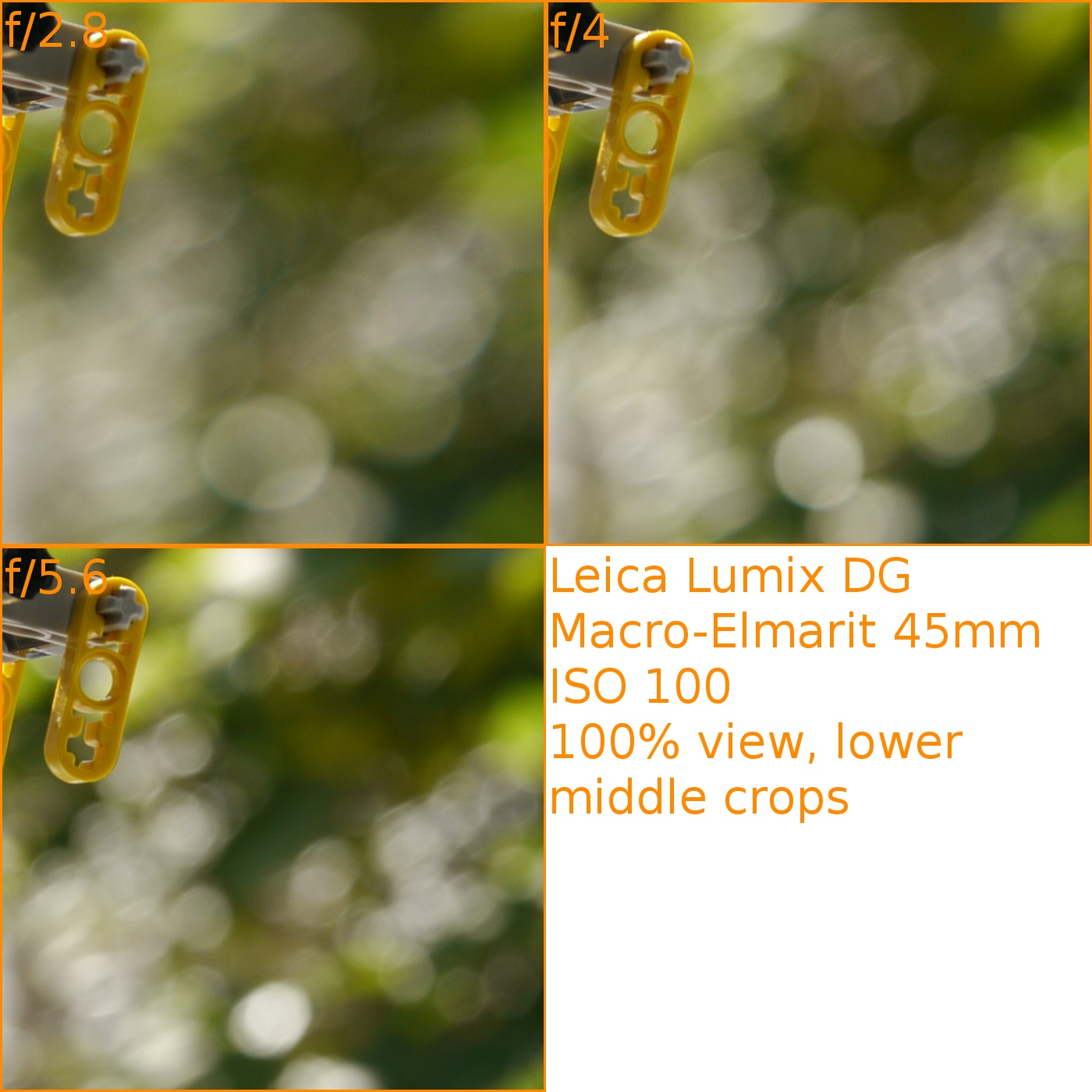
To learn more about the bokeh characteristics, let's look at 100% crops from various parts of the image. Here are 100% view crops from the centre of the image, at f/2.8, f/4 and f/5.6. Click on an image to see an enlarged view.


And crops from the upper right hand corner:


Finally, crops from the lower middle region:


Conclusion

The bokeh looks better at larger apertures. There is still some ringing around the highlights even at f/2.8. This causes some distraction, even in the downscaled view. However, keep in mind that this is a very tricky situation for any lens to render.

Thursday, 1 July 2010

Bokeh comparison @ 45mm f/5.6

I have made a comparison of the bokeh (out of focus rendering) for three lenses, Leica Lumix DG Macro-Elmarit 45mm, Panasonic Lumix G 45-200mm and Panasonic Lumix G HD 14-140mm. These lenses share a common focal length, 45mm. The largest common aperture is f/5.6, so I used that for all lenses in my study. (Actually, the maximum aperture of the 14-140mm lens is f/5.5 at 45mm, but I rounded it off to f/5.6.)

Anyone having the Leica Lumix DG Macro-Elmarit 45mm are likely to be using larger apertures than f/5.6 for non macro images. I have also made a comparison of the bokeh rendering for larger apertures for this lens, and a bokeh comparison with the Olympus Zuiko Digital 50mm f/2 macro.

Monday, 5 April 2010

Portrait lens

Traditionally, a portrait lens is one that has around 85-105mm focal length (35mm equvivalent), and a fast aperture to allow shallow depth of field to blur the background. The closest we have at the moment in the Micro Four Thirds lens lineup is the Olympus M.Zuiko Digital 45mm f/1.8 prime lens.

The fast aperture is easy to understand. At a small, slow aperture, the background will be less blurred, and will distract the viewer from the main focus of the image: The face. So you will want a fast, large aperture to blur the background and avoid distracting elements in the background.

But how about the focal length? To study this, I have photographed the same face with various focal lengths from 9 to 70mm with the Panasonic Lumix GH1 and the Lumix HD 14-140mm lens. I also used the Olympus Four Thirds 9-18mm wide angle zoom lens for the first picture. This corresponds to 18mm-140mm on traditional film based 35mm cameras. The distance from the camera to the face was shortest with the shortest focal length. As I zoomed in, I needed to step backwards.

Here is the series of photos:
9mm

14mm

18mm

25mm

35mm


50mm

70mm

As you can see, in the first pictures, the perspective is distorted. The nose appears much too large. This is not due to any flaw in the lens, or due to the camera, but due to the fact that I needed to get very close to make the face fill the entire frame at 9mm focal length.

So close, in fact, that the lens was not able to focus close enough. To get the face reasonably in focus, I focused as close as possible, and used a small aperture to make the depth of field wide. The bicycle in the background is almost in focus in the first images, due to the small aperture.

The distorted perspective is due to being close to the subject, to fill the face into the entire frame. You would get the same distorted image if you looked at the face with your own eyes, given the same distance. But you don't normally get so close to someone's face.

The first frame is obviously distorted. The last one looks normal. I would say that the one taken with 35mm focal length also looks slightly distorted. So to achieve enough distance to the subject to avoid a distorted perspective, you need approximately 50mm focal length on Micro Four Thirds.

You could use a smaller focal length as well. If you still keep some more distance to the subject, you could get the face to fill just some part of the image, and be distortion free. But such a picture would not be a portrait.

This is exactly the reason why traditional portrait lenses are around 85-105mm, corresponding to about 42-53mm of Micro Four Thirds.

Panasonic Leica 45mm f/2.8 1:1 macro

Based on this, you will understand that the choice of focal length for the Panasonic Leica DG Macro-Elmarit 45mm f/2.8 1:1 Macro Mega O.I.S. was no coincidence. 45mm corresponds to a portrait lens for Micro Four Thirds, and gives you enough distance to the subject for taking distortion free portraits. However, the aperture size, at f/2.8, is not really large enough to isolate the background from the face. f/2 or larger would have been desirable.


Olympus 45mm f/1.8

In the summer 2011, Olympus launched a true portrait prime lens for the Micro Four Thirds system, the Olympus M.Zuiko Digital 45mm f/1.8. While I'm sure some will still be disappointed with the maximum apeture, it could have been even larger at f/1.4, for example, I think this is the best portrait lens for the format at the moment.


Panasonic 20mm f/1.7

The Panasonic Lumix 20mm f/1.7 is a popular lens for taking available light pictures of people, but it is not a portrait lens. You cannot fill the subject's face in the entire frame and avoid distortion with this lens. With that said, the lens is very sharp, and you should be able to get away with stepping back a bit, and cropping the picture later. This is not an optimal solution, but it should work well in many cases.

The Panasonic Lumix 20mm f/1.7 lens is also good for taking environmental portraits.


Olympus 50mm f/2 1:2 macro

On the other hand, the Four Thirds lens Olympus 50mm f/2 macro can be considered a portrait lens. The focal length is in the correct range, and the aperture is large enough to blur the background sufficiently.


All kit lenses include the typical portrait focal length area. Both the Olympus 14-42mm and the Panasonic 14-45mm extend to around 85-90mm in 35mm film equivalent. However, at the maximum tele, the aperture is not very impressive at f/5.6. With this aperture, you need to check the background, and try to make sure it does not distract too much from the main subject, the person.
Panasonic 45-200mm f/4-5.6

The Panasonic Lumix 45-200mm f/4-5.6 Mega O.I.S. does cover the typical portrait field of view. However, with a maximum aperture of f/4 at 45mm, it can not really be considered a genuine portrait zoom. With f/4, you need to watch the background to make sure it does not distract too much. If the background is even, though, I see no reason why you should not use it for portraits.

Other tele zooms can be used in the same way, e.g., the Lumix X 45-175mm f/4-5.6, Lumix G 45-150mm f/4-5.6 and the Olympus 40-150mm f/4-5.6. Normally, one would want to pair tele zoom lenses with cameras of the same brand, i.e., use a Panasonic lens on a Panasonic camera. The reason is that Panasonic cameras don't have built in in-camera image stabilization, like the Olympus cameras do.


Panasonic Leica 25mm f/1.4

The Panasonic Leica DG Summilux 25mm f/1.4 Asph lens corresponds to a "normal" lens on a traditional film camera. While it is longer than the 20mm pancake lens, it is still not a portrait lens. If you go close enough to fill the face of the subject into the entire frame, then you are too close to get a distortion free image. On the other hand, with the slightly longer focal length, it is certainly better suited for low light photos of a person's face and shoulders.


On 35mm film based cameras, a portrait zoom is typically 70-200mm f/2.8. This lens allows portraits at various distances, with a minimum of distortion, and reasonably blurred background. In the Four Thirds system for DSLR cameras, the Olympus 35-100mm f/2 is a typical portrait zoom. For the Micro Four Thirds system, there is the Lumix X 35-100mm f/2.8, which can be called a portrait zoom.


For APS-C DSLR cameras, portrait zooms typically have 50-135mm f/2.8 specifications. Pentax, Tokina and Sigma have lenses in that category.