Before trying to answer this question, let's take a step back and ask: Why would you need more lenses?
Compact cameras and interchangeable lens cameras
A user coming from the compact camera world may be confused by the apparent need for more lenses. Even fairly inexpensive compact cameras comprise a feature packed lens: A zoom range of 12x or more, starting at a very wide angle, macro functionality, and even pretty decent maximum aperture (a low f-value). All this in a small package.
When "upgrading" to a Micro Four Thirds camera with the kit lens, they may easily be disappointed. They now have a larger, more expensive camera, which only features a 3x zoom lens, starting at 28mm equivalent wide angle, and no macro functionality. How is this an upgrade at all?
The answer to this lies in the size of the imaging sensor. Compact cameras generally have a very small sensor, which allows the manufacturer to design very small lenses that have all the functionality most people would want. With a larger sensor, it is physically impossible to design a lens which does the same, at least within reasonable economical constraints.
This picture illustrates the relative size of sensors. The Four Thirds sensor (red) is one quarter the size of the classic 135 negative film (black), but still a lot larger than the sensor in mobile phones and basic compact cameras (orange):

So why don't all cameras have small sensors, so that the built-in lens can solve all the photographic needs of the user?
It turns out that a camera with a larger sensor has other advantages. The main four advantages for a larger sensor camera, as I see them, are:
1. Ergonomics. A larger sensor camera needs to be larger, and hence the camera itself has more space for buttons, wheels and levers. This gives the user a better grip to hold, and easier access to functions through the user interface. Compact cameras only have room for a small handful of buttons, and require the user to use menus to access the camera functions.
2. Sensitivity. With a larger sensor, each photosite has a larger physical area, meaning that you can theoretically get a better image quality with in a low light situation (high ISO). This can also give a better dynamic range, and overall better image quality.
3. Selective focus and bokeh. With a small lens camera, the depth of focus is very wide, meaning that a lot of the image will be in focus. While this is good for a lot of applications, larger sensor cameras allow for selective focus, making the background of the image go out of focus.
4. Diffraction. A physical concept called diffraction dictates that there is a limit to how high the pixel density on the sensor can be. Hence, to get more megapixels, the sensor needs to be physically larger.
Here I have compared the image quality of the GH2 with the basic kit lens with a small sensor compact camera. The GH2 has significantly better image quality, due to the larger sensor size.
However, the disadvantage with a large sensor camera is that not one single lens will cover all the photographic needs. Hence, the camera is often designed to have interchangeable lenses, so you can change lens depending on what kind of image you intend to take.
Micro Four Thirds Lenses
The main players in the Micro Four Thirds camera system are Olympus and Panasonic. Since all cameras and lenses are from the same system, they can be combined. So you can put an Olympus lens on a Panasonic camera, and vice versa. In some cases, however, it makes sense to match the manufacturer when buying lenses. I will comment this later in the article.
In this article, I have split the content into a number of lens categories. Before going into the details, here is a brief description of each category:
Pancake Lenses: This is not a common lens category. For example, for the Nikon lens system, existing for more than fifty years, there is only one single lens which is generally regarded as a pancake lens. Pentax has a handful of pancake lenses. But for the Micro Four Thirds lens system, size is important, which may be why pancake lenses are more common here.
Low Light Lenses: For use in low light environment, for example when you want to photography people indoor without using a flash, for concert photography, and so on.
Kit Zoom Lenses: When you buy a camera, you often have the option to buy a basic zoom lens in a kit together with the camera. This lens is generally small, light, cheap, and often has a zoom range of around 3x. It is not too common to buy this type of lens standalone.
Tele Lenses: Long focal length tele lenses are used to photograph things that are far away.
Wide Angle Lenses: Covering a very wide field of view, these lenses allow you to pack a lot of features into one single image. However, the wide perspective can give unexpected perspective distortions.
Superzoom Lenses: These lenses are designed for covering a wide range of focal lengths, from wide angle to tele. Hence, having one of these lenses on your camera should remove the need to change lens often. The zoom range of these lenses is usually 10x or more.
Pro zoom lenses: High end zoom lenses, usually with a large, constant maximum aperture, quick autofocus, and commonly with weather protection. There are two so far from Panasonic: The Lumix X 12-35mm f/2.8 and the Lumix X 35-100mm f/2.8. Both have classic focal length ranges for lenses of these types, and are much smaller than the same kind of lenses for DSLR cameras.
Also, Olympus has launched the 12-40mm f/2.8 pro standard zoom lens. The 40-150mm f/2.8 high end tele zoom lens can use a special tele converter which makes it into a 70-210mm f/4 lens, quite useful for sports and wildlife.
Portrait Lenses: For taking portrait pictures, meaning a headshot, or a head-and-shoulders picture, usually at about 1-2 meters distance.
Specialty Lenses: Other lenses that don't belong in other categories.
Here are my opinions about the lenses in these categories:
Pancake Lenses
The lenses in this category are prime lenses, meaning that they are not zooms. They have a constant focal length, and hence, a constant field of view.
There are three choices: Panasonic Lumix G 14mm f/2.5, Olympus M.Zuiko 17mm f/2.8, and Panasonic Lumix G 20mm f/1.7 (from left to right below, not to scale).


These lenses are somewhat different. The Lumix 14mm lens is the widest, obviously, and also the smallest and lightest.
The Lumix 20mm lens is the fastest, it has the largest maximum aperture. This makes it the most useful for low light photography. Also, with the longest focal length, it is more useful for photographing a person, but not so good for a group of persons. On the other hand, it has a fairly slow and noisy autofocus.
In the summer 2013, this lens was discontinued, and a new version of the lens, Lumix G 20mm f/1.7 II (H-HS020A) was released. The new version has the same basic specifications, and appears to have the same optical design. The exterior design is new, though, with a black or silver metal finish.
As the new lens has the same optical design, it still has the old style focus assembly which moves all the lenses back and forth. Panasonic may have improved the focus mechanism, so that it operates quicker and less audibly, but as long as it does not feature internal focusing, it just cannot be as quick as the other Panasonic Micro Four Thirds lenses. Internal focusing would have required a totally new optical design.
The new designs of the Panasonic Lumix G 20mm f/1.7 II:
 |  |
Here is my article which compares the 14mm and 20mm lenses from Panasonic.
The Olympus 17mm lens doesn't stand out too much. It is not the smallest, nor the widest or fastest of the pancakes. On the other hand, it is the cheapest. The field of view lies between the two Panasonic pancake lenses.
Do you need to match the manufacturer when buying the pancake lenses? Not really. If you put a Panasonic lens on an Olympus camera, you don't get automatic software correction of some chromatic aberration artifacts. But the lenses don't exhibit too much of these artifacts anyway, so this is no big problem.
So what lens should you buy? If autofocus (AF) during video is important, don't choose the Lumix G 20mm f/1.7 lens. It has too slow AF, and can easily lose the focus for several seconds during video recording, especially in low light.
If low light performance is important, of course you should choose the one with the largest maximum aperture, which is the Panasonic Lumix G 20mm f/1.7.
None of these lenses can be considered a portrait lens: They are too short for that. However, they can all be used for environmental portraits, in which you include more of the person than just the head and shoulders. For pictures of a group of people, one would normally choose the widest, the Panasonic Lumix G 14mm f/2.5.
All these lenses are considered to be good optically, however, people often say that the Olympus 17mm f/2.8 is slightly inferior to the Panasonic Lumix pancake lenses.
Low Light Lenses
A low light lens is a lens designed for being used in situation where the available light is low, and you don't want to use a flash. This could be indoor, at a concert, outdoor at night, and so on.
The lenses in this category have a large maximum aperture, and hence, a low f-number. The Panasonic Lumix G 20mm f/1.7 from the pancake category is also a low light lens. With an aperture of f/1.7, it is among the fastest Micro Four Thirds lenses available.
At the moment, the ultimate low light lens is the Panasonic Leica DG Summilux 25mm f/1.4. Corresponding to a classic normal lens for a film based SLR system, 50mm f/1.4, this lens is good for photographing in low light environments, and when you want a high degree of selective focus and bokeh. Sporting a Leica logo, it is a rather expensive lens:

25mm is perhaps not the optimal focal length for a low light lens. It is too short for a portrait lens, and too long for photographing a group of people indoor. But, it remains a classic focal length for bright lenses, and I am sure many people like this lens a lot.
From Olympus, there is the Olympus M.Zuiko Digital 17mm f/1.8. It has the premium metal finish, just like the Olympus M.Zuiko Digital 12mm f/2 and the Olympus M.Zuiko Digital 75mm f/1.8, and is a somewhat expensive lens. It corresponds to the classic wide angle field of view, at 34mm equivalent. At this field of view, the maximum aperture of f/1.8 is quite impressive for a relatively compact size of the lens:

Olympus have made their interpretation of the classic normal lens, the Olympus 25mm f/1.8:

It is available in silver or black finish, and does not have the same high end finish as the Olympus M.Zuiko Digital 17mm f/1.8 or Olympus M.Zuiko Digital 75mm f/1.8. Still, the lens performs well, and is popular, despite a somewhat steep price.
There is also another low light lens available at a rather reasonable cost: The Olympus M.Zuiko Digital 45mm f/1.8. (See the Portrait Lens section below for more discussion.) On a Panasonic body, you will have no image stabilization, which may be a problem with this fairly long focal length. You cannot expect to video record stably without some support.
Kit Zoom Lenses
Kit zoom lenses are usually bought together with the camera. So to include them in this guide might seem a bit superfluous. However, for the sake of completeness, here are my opinions on them.
In this category, it is wise to pair lens and camera according to the brand. This is because Panasonic and Olympus have chosen different philosophies when it comes to Image Stabilization.
Panasonic
Five lenses are available with the Panasonic brand: Lumix G 14-45mm f/3.5-5.6, Lumix G 14-42mm f/3.5-5.6, Lumix X PZ 14-42mm f/3.5-5.6, Lumix G 14-42mm f/3.5-5.6 II, and Lumix G 12-32mm f/3.5-5.6 all with OIS built in. Shown below, from left to right:


The lenses above are also sorted according to date of launch: the 14-45mm lens was the very first kit zoom lens, sold with the Panasonic Lumix G1 camera. It was later replaced with the newer kit zoom, the 14-42mm. In 2011, the pancake kit zoom with powerzoom, Lumix X PZ 14-42mm was launched.
The third kit lens announced, the Lumix X PZ 14-42mm f/3.5-5.6, is completely different. It is made to achieve two extra goals: To be very compact, and to feature a power zoom. It extends using an internal motor before being usable upon powerup. Zooming can only be done with the zoom lever on the lens side, which engages a dedicated internal zoom motor.
Motorized zoom is largely a nuisance when photographing. You have much better control using a zoom ring. However, if you intend to zoom during video recording, a power zoom is needed. It is virtually impossible to zoom smoothly using your hand. Many would say that zooming during video should be avoided, as it seldom looks good anyway. But with a motor zoom, you have a much better chance of pulling it off.
It doesn't even have a focus ring. To focus, you must use a focus lever on the side. This, combined with the lack of a zoom ring, makes the lens somewhat awkward for still image photography. So if you're only interested in still images, this lens is not ideal for you. Unless, of course, you also value compactness.
Personally, I have found the Lumix X PZ 14-42mm f/3.5-5.6 compact zoom lens to have an image quality not up to the standards of the cheaper Lumix G 14-42mm f/3.5-5.6. However, I still use it, due to its compactness.
Finally, the Lumix G 14-42mm f/3.5-5.6 II was launched in 2013, for use as a kit lens with the Panasonic GF6 and Panasonic G6 cameras. It is more compact than the first version of the lens, although not as compact as Lumix X PZ 14-42mm f/3.5-5.6 compact zoom lens. So far, reports indicate that the Lumix G 14-42mm f/3.5-5.6 II is a good lens, with good sharpness, and a good quality construction, including a steel mount.
| Lumix Lens | G 14-45mm | G 14-42mm | X PZ 14-42mm | G 14-42 II | G 12-32mm |
| Year released | 2008 | 2010 | 2011 | 2013 | 2014 |
| Diameter | 60mm | 61mm | 61mm | 56mm | 56mm |
| Length | 60mm | 64mm | 27mm | 49mm | 24mm |
| Weight | 195g | 165g | 95g | 110g | 70g |
| Filter thread | 52mm | 52mm | 37mm | 46mm | 37mm |
| Front lens diameter | 45mm | 30mm | 21mm | 25mm |
So what lens should you choose? The first kit zoom, the 14-45mm, is probably the better than the second, the first 14-42mm version. The first version of the 14-42mm lens was made mostly to cut costs, and features a 25% smaller front lens element. It is also lighter, partially due to the plastic lens mount. The second version of the 14-42mm kit zoom lens is probably better than the first version.
Personally, I think you shouldn't spend the extra effort to get the now discontinued, older, 14-45mm lens. While it is probably better than the second, the 14-42mm is perfectly fine, in my opinion. You should rather spend the effort to take pictures, and save the money for future lens purchases.
If you value compactness and like wide angle, get the Lumix G 12-32mm, it has quite good image quality.
The Lumix X PZ 14-42mm f/3.5-5.6 compact zoom lens is fascinating, with the compact size and power zoom function. But the image quality is not really impressive.
If you can live with the normal size, get the newest 14-42mm zoom lens. It is considered very good for a kit zoom lens.
Olympus
Olympus also offers five kit lenses: Olympus M.Zuiko Digital ED 14-42mm f/3.5-5.6, Olympus M.Zuiko Digital ED 14-42mm f/3.5-5.6 II, Olympus M.Zuiko Digital ED 14-42mm F3.5-5.6 II R, Olympus M.Zuiko Digital ED 12-50mm f/3.5-6.3 EZ, and Olympus M.Zuiko Digital ED 14-42mm f/3.5-5.6 EZ (left to right below):


With the basic Olympus kit lens, the choice is simple: Get the newest one. The II-version is better optically than the original kit lens. And the 14-42mm II R-version is largely the same lens, but focuses better, especially during video.
The Olympus M.Zuiko Digital ED 12-50mm f/3.5-6.3 EZ is quite versatile, as spans a wide focal length, from a very wide wide angle, and beyond the typical portrait focal length of 42mm. It is weather protected, so it should be able to stand some water spray. Also, it has power zoom, for more smooth zooming during video recording. On top of all this, it offers some macro capabilities, with a maximum magnification of 0.36x.
The Olympus M.Zuiko Digital ED 14-42mm f/3.5-5.6 EZ is a pancake lens, designed to be as compact as possible when not in use. As you turn on the camera, the lens automatically extends, and is ready for use quickly. If you like a compact lens, then this one is for you. It has been getting mixed reviews, though, in terms of optical performance.
Tele Lenses
Tele lenses are designed to photograph items that are further away. The zoom range generally starts at the portrait lens focal length, corresponding to around 40-45mm for the Four Thirds format. Since they usually feature an aperture of f/4 at this focal length, better than the kit zooms, they can be used as portrait lenses if you mind the background a bit.
Other uses for tele lenses are spectator sports, wildlife, and other situations where you cannot get closer to what you are photographing.
With the narrow field of view of tele lenses, image stabilization is important, and it makes sense to match the manufacturer of the camera and lens.
Panasonic
The Lumix G 45-200mm f/4-5.6 is the most reasonably priced tele lens for Panasonic cameras, and in my opinion, it gives a good value for money. It features quick and silent AF, and good sharpness. In the longer end, around 150-200mm, the sharpness is not as good, but still usable.

In 2012, a new, more compact tele zoom lens was announced. It is the Lumix G 45-150mm f/4-5.6. It is 27% shorter than the 45-200mm lens, and carries an inexpensive price tag:

For Panasonic camera users who want a tele lens, I would recommend the Lumix G 45-200mm f/4-5.6 lens, or the Lumix G 45-150mm f/4-5.6, depending on how you value the compactness.
The only exception is if you know that you need a very long lens, in which case it may make more sense to buy the bigger brother, the Lumix G 100-300mm f/4-5.6:

While the smaller lens starts at the typical portrait lens focal length, 45mm, the larger starts at 100mm. 100mm is already a very long lens for the Four Thirds format. So as the 45-200mm lens can be used as a "walk around lens", the 100-300mm lens remains a specialized long tele lens at all zoom configurations, with a more limited area of use.
Just like in the kit zoom category, Panasonic has a power zoom lens, the Lumix X PZ 45-175mm f/4-5.6:

It is more compact and lighter than the Lumix G 45-200mm tele zoom lens. Also, it does not extend when zooming, meaning that it is a more solid construction. There is no wobbling front segment. It's main feature is the power zoom, which works very well. It can be operated by a lever, or by a "zoom by wire" electronically coupled zoom ring.
In my test, it has better optical properties than the older Lumix G 45-200mm lens.
Olympus
Olympus have got two tele lenses, with one covering longer focal lengths. Again, get the shorter lens, the Olympus M.Zuiko Digital ED 40-150mm f/4-5.6 for most tele needs. There is also a newer version with better autofocus performance, the Olympus M.Zuiko Digital ED 40-150mm f/4-5.6 R. As the optical formula is similar, get the newest version (right, below), if you have the possibility:


The longer lens, the Olympus M.Zuiko Digital ED 75-300mm f/4.8-6.7, is built to be compact, and for that reason features a smaller maximum aperture than the similar lens from Panasonic. This makes it somewhat less suitable for applications where you need to capture movement with a fast shutter speed, e.g., sports, or where the light is limited.

This is a lens for those who value compactness of their system, and are willing to pay for it. In 2013, a new version of this lens was launched. It has a new design, and the zoom ring is a bit stiffer. Optically, it is the same, but comes at a lower price!
Wide Angle Lenses
To capture a wide cityscape, or a group of people at a short distance, you need a wide lens. There are some quite wide lenses available for the system. As image stabilization is not as needed for short focal lengths, I'd say you can put these lenses on both Panasonic and Olympus bodies. Don't worry about the lack of image stabilization on Panasonic bodies, is my opinion.
The (relatively) low cost alternative at the moment is the Olympus M.Zuiko Digital 9-18mm f/4-5.6:

It has a reasonably small size, low weight, and performs well. The focal length range is useful: Going from a pretty extreme wide angle to a "normal" field of view in the long end.
For the person who wants even more extreme wide angle performance, the Panasonic Lumix G 7-14mm f/4 is the right choice. It will set you back more in terms of cost, but offers a staggering wide angle view in the short end. It performs very well optically, and is built to a high quality.

The Olympus M.Zuiko Digital 12mm f/2 is a prime wide angle lens. At 12mm, it is not extremely wide, but should be wide enough for many applications. It has a construction involving a lot of nicely polished metal, and is quite unusual for having a focus scale, and a depth of field scale:

It is a pricey lens, and you probably pay some premium for the retro metal construction.
Superzoom Lenses
Superzoom lenses mimic the "compact camera feeling", in that they enable a very large zoom range. Starting at 28mm film equivalent wide angle, and with a zoom ratio of 10x or more, they cover the focal length people tend to use most. The downside is that the lenses are large, expensive, and don't have very impressive maximum aperture.
As image stabilization is important in the longer focal length range of these lenses, it is recommended that you buy the Panasonic lens for use on a Panasonic camera, and the Olympus lens for an Olympus camera.
From Panasonic, a new lens was launched in April 2013. The Lumix G HD 14-140mm f/3.5-5.6 improves upon the the predecessor by having a smaller size (58mm front lens thread rather than 67mm for the older lens), comes with a better aperture range (f/3.5-5.6, rather than f/4-5.8), and even comes at a lower list price.
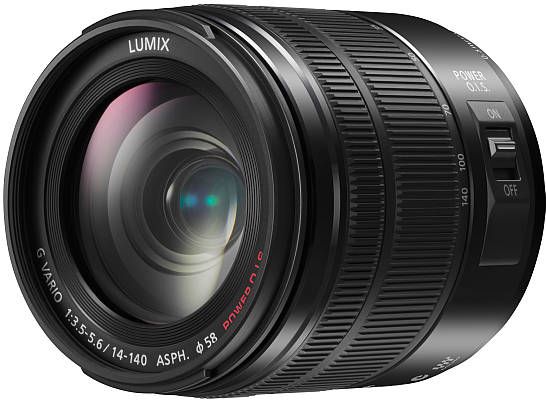
I would recommend getting the newer lens. I have tested it, and found that it improves on the predecessor in almost any conceivable way.
Should you buy a superzoom lens, rather than the Lumix G 14-42mm f/3.5-5.6 and the Lumix G 45-200mm f/4-5.6, which when combined cover a larger focal length range at a smaller price? That depends. Combining two lenses may mean that you miss the occasional shot: Changing between the lenses takes some time, while just rotating the zoom ring of the superzoom lens is very quick.
In my experience, the new Panasonic 14-140mm superzoom lens is as good as the separate lenses through most of the zoom range, and hence, for versatility it is often better to get the superzoom lens.
The Olympus M.Zuiko Digital ED 14-150mm f/4-5.6 II features a slightly longer zoom range. However, that is just barely significant. What is more significant, is the relatively smaller size and weight. The Olympus superzoom lens is much more portable:

According to what I have read, the Olympus superzoom lens has adequate image quality.
There is also a competing lens from Tamron, the Tamron 14-150mm F/3.5-5.8 Di III. Not featuring Optical Image Stabilization (O.I.S.), I'm guessing this lens is intended as an alternative to the Olympus 14-150mm f/3.5-5.6.
Pro zoom lenses
Again, one would normally match brands when buying these pro zoom lenses. From Panasonic, we have two lenses: The Lumix X 12-35mm f/2.8 and the Lumix X 35-100mm f/2.8. The first is a standard zoom lens, while the latter is a tele zoom lens.
Both of these lenses are generally considered very good, and relatively compact compared with similar lenses for other systems. The are rather expensive, though. In my bokeh test, I saw that the Lumix X 12-35mm lens has quite nice bokeh, while the Lumix X 35-100mm lens has non-round out of focus highlights off the image centre, quite normal for Panasonic lenses. This is probably no issue in low contrast situations, e.g., daylight, but can be distracting for night photos.
From Olympus, similar lenses were announced in 2013. The Olympus 12-40mm f/2.8 pro standard zoom has a slightly longer zoom range than the corresponding lens from Panasonic, making it more useful for, e.g., portraits.
This lens is still quite new, but reviewers generally say that the image quality is very good. You could very well use it on Panasonic cameras, but be aware that since it does not feature OIS, you will get no image stabilization available for video recording, for example.
Olympus also have a longer pro zoom lens, with the impressive specifications 40-150mm f/2.8. This is large, heavy, and very expensive lens. It performs very well. It can be used with an optional 1.4x converter, which turns it into a 70-210mm f/4 lens.
Portrait Lenses
According to the traditional understanding of the word, a portrait lens is a lens with a focal length of around 42-52mm (on a Four Thirds size sensor), with a fast maximum aperture. At the moment, there are several lenses in the Micro Four Thirds lineup which satisfies this.
In the lower end of the price scale, there are the Olympus M.Zuiko Digital 45mm f/1.8 (left), and the Lumix G 42.5mm f/1.7 OIS (right):
 |  |
These lenses are priced at a fairly reasonable level, which makes them a must have for Micro Four Thirds users who are serious about portrait photography.
With no Optical Image Stabilization (OIS) built in, the Olympus is not too good for handheld video recording, neither with an Olympus camera, nor with a Panasonic camera. Anyone seriously into video recording will be better off with the Panasonic lens. When buying one of these lenses, I would match the brand with that of the camera.
Some would say that a portrait lens must have a very fast aperture, preferably f/1.4 or better. They might be dissatisfied with the f/1.8 maximum aperture of the 45mm Olympus lens, and the similar aperture of the Lumix lens. I would personally say that f/1.8 is large enough to get a sufficiently thin depth of focus (DOF) for portrait photography.
In the higher end of the price scale, Olympus also has a premium portrait lens, the Olympus M.ZD ED 75mm f/1.8:

This is an expensive, well built tele lens with a large maximum aperture. It is generally considered to be one of the best Micro Four Thirds lenses.
In terms of price, it is topped still by the Leica branded Lumix 42.5mm f/1.2 Nocticron. With the record fast (for a Micro Four Thirds autofocus lens) aperture of f/1.2, it is a highly coveted lens. It is good for those who like to take photographs in dim light, e.g., indoors, or who like the thin DoF effect.
The Panasonic Leica 45mm f/2.8 1:1 macro lens could also be used as a portrait lens, in my opinion, even if the maximum aperture is much smaller than the traditional definition of a portrait lens dictates. As long as you make sure the background is not too distracting, you should be fine using this lens as a portrait lens, in my opinion. (See the Specialty Lenses category below.)
For a low cost alternative, you could consider using the Sigma 60mm f/2.8 DN. It is slightly long for a portrait lens, and would be good for headshots at a distance of 1.5-2m. Another use is candid people pictures. The lens is very sharp in the centre, and has a very smooth and nice bokeh. The corners could have been sharper, in my opinion, but this is hardly an issue for a portrait lens anyway.
Yet another low cost option is to get the Sigma 30mm f/2.8. It is a tad bit short for a portrait lens, but I think it is a good alternative on a low budget.
Sigma lenses
Sigma joined the Micro Four Thirds lineup with two prime lenses in 2012: The Sigma 19mm f/2.8 EX DN and the Sigma 30mm f/2.8 EX DN:


Sigma 19mm f/2.8 and 30mm f/2.8 (not to scale)
These lenses were designed by Sigma to be used on several mirrorless formats, including the Sony NEX series, Sony E-mount. The NEX cameras use an APS-C sized sensor, slightly larger than the Four Thirds sensor, with an 1.6x crop factor.
On this crop factor, the 19mm lens corresponds to a traditional wide angle lens, while on Micro Four Thirds it is not as interesting. It is very close to the Lumix G 20mm f/1.7. As the Lumix G 20mm lens is more compact, and brighter, I don't see the need for the Sigma 19mm lens. On the other hand, the Sigma 19mm lens focuses much quicker and more silently, and is cheaper. If this is important to you, it may be an interesting lens. See my review here, which compares the focus speed and image quality with the Lumix G 20mm f/1.7 lens.
The Sigma 30mm f/2.8 EX DN lens, on the other hand, is more interesting in my opinion. As I see it, it has quite good image quality, and can be used as a portrait lens. If you want good image quality on a budget, this might be a lens to consider.
These lenses are in fact already discontinued. Replacing them in 2013 are new versions, called Sigma 19mm f/2.8 DN and Sigma 30mm f/2.8 DN. They are part of Sigma's "Art" line of lenses. They have the same optical designs, but a different exterior, available in black or silver metal finish. The focus ring is now made out of smooth metal:

Sigma 19mm f/2.8 DN (2013 version, "Art lens")
From an ergonomic point of view, this is a strange choice. It looks like a smooth metal focus ring will be less convenient to use. In practice, the ring rotates quite easily, so this is no real issue, though. It looks like the remake is all about a new styling, while retaining the original optical properties.
In 2013, Sigma also released their third lens for the Micro Four Thirds system, the Sigma 60mm f/2.8 DN. It corresponds to a 120mm tele prime lens in 35mm equivalent terms, and also gets the new metal finish. Based on reviews, people tend to think that it is a good lens, being sharp and having a nice bokeh.
Specialty Lenses
If you are interested in macro photography there are three lenses available at the moment, the Panasonic Leica 45mm f/2.8 1:1 macro lens, the Olympus 60mm f/2.8 1:1 macro lens, and the Lumix G 30mm f/2.8 1:1 macro lens. With a macro reproduction rate of 1:1, you can photograph items down to a size of 17mm x 13mm:


In my opinion, they can also double as portrait lenses, even though the aperture could have been larger for this application.
The Panasonic 45mm lens focuses somewhat slowly, and for that reason is not ideal for video recording with AF. The optical image stabilization is not so useful for macro applications. It is a pricey lens, but the optical performance is good.
The Olympus lens has the same reproduction rate, so you can use either to photograph equally small objects. The Olympus lens has a somewhat longer working distance, though, the distance from the front lens element to the item you are photographing. This can be useful if you intend to photograph bugs which become shy when you get too close.
Without Optical Image Stabilization (O.I.S.), the Olympus macro lens is not so well suited for general photography on a Panasonic camera. If you use it on a tripod, though, as one would often do with macro photography, this is of course a non-issue.
The Lumix G 30mm f/2.8 is the least expensive lens of the three. With the relatively short focal length, it is not as well suited for photographing live bugs, but does perfectly well for flowers and the like.
The lenses with the very widest field of view are the Lumix G 8mm f/3.5 Fisheye lens and the Samyang/Rokinon 7.5mm f/3.5 Fisheye lens.
The Lumix G 8mm focuses very quickly, and has a very short minimum focus distance, which can be used for some interesting effects.

With the fisheye projection, it has a somewhat limited usefulness, and could be viewed as a novelty lens by some. Here is a discussion about how to use a fisheye lens.

Due to its lower cost and good optics, the Samyang/Rokinon 7.5mm f/3.5 fisheye lens can be a good alternative to the Lumix G 8mm f/3.5 fisheye lens.
From Olympus, there is also a cheap and simple 9mm f/8 fisheye body cap lens:

I would not recommend buying this lens. It is rather crudely constructed, and lacks any aperture mechanism at all. Further, it is not a true fisheye lens in the sense that the diagonal covers 180 degrees field of view. The diagonal field of view is only 140 degrees.
Buy Olympus 9mm f/8 fisheye body cap lens only if you want a cheap and compact lens for the occasional fisheye shot. Otherwise, get the Samyang/Rokinon 7.5mm f/3.5 Fisheye lens, which is somewhat more expensive, but a lot more useful.
Panasonic has launched a 3D lens. It features two fixed focus, fixed aperture lenses at 12.5mm f/12:

But don't think that this is a wide angle lens, with the 12.5mm focal length. As the lenses project much smaller image circles, there is an additional crop factor of 2.4, giving a 60mm field of view, relative to a 135 film camera standard. Since the two images projected are small, the resolution of the images are limited.
This lens only works on fairly recent Panasonic camera bodies. And, contrary to what most people would expect, it cannot be used to record 3D videos.
The 3D stereo base is small, only about 10mm. So the 3D effect is only significant for fairly close macro images. Photographing objects that are further away yields a limited stereo effect. So the usefulness of this lens is not very high. Read my review here.
Conclusion
The Micro Four Thirds lens lineup has become quite good. People with a camera and a basic kit lens most likely want to achieve something new with their lens purchase. Here are some common needs, as I see it:
For a more compact lens, look at the pancake lenses. The Panasonic Lumix G 20mm f/1.7 combines a small size with a good low light performance, and for that reason has become an instant classic. The Panasonic Lumix G 14mm f/2.5 has a very impressive small size, and is good for wide angle and fast AF.
For extending the tele effect of the kit zoom, complement it with the Lumix G 45-200mm f/4-5.6 (for Panasonic cameras), or the Olympus M.Zuiko Digital 40-150mm f/4-5.6. You could also consider the newer powerzoom Panasonic Lumix X PZ 45-175mm f/4-5.6, especially if you are into video, or if compactness and lightness is important for you. For birding or safari use, the Lumix G 100-300mm f/4-5.6 is pretty much the only choice at the moment.
For a one lens does it all superzoom, get the Panasonic Lumix G HD 14-140mm f/3.5-5.6 for use on a Panasonic camera, or the Olympus M.Zuiko 14-150mm f/4-5.6 for use on an Olympus camera.
In the wide angle category, the Olympus M.Zuiko Digital 9-18mm f/4-5.6 gives a good value for money.
If you are interested in portraits, the Olympus M.Zuiko Digital 45mm f/1.8 appears to be a good choice, for a reasonable price. Panasonic camera users should probably rather consider the Lumix G 42.5mm f/1.7 OIS, also reasonably priced.
If you want the luxury feel, and let me say that there is nothing wrong with that, consider the Olympus M.Zuiko Digital 12mm f/2 very wide angle lens, the Olympus M.Zuiko Digital 17mm f/1.8 wide lens, or the Olympus M.Zuiko Digital 75mm f/1.8, all with a retro metal construction.
Also look at the Panasonic Leica 42.5mm f/1.2 portrait lens, or the Panasonic Leica 25mm f/1.4. The metal construction of the Olympus lenses, and the premium Leica branding of the Panasonic lenses contribute to a higher price level, but you surely get a good lens in return.
(The images in this article have been picked from four-thirds.org.)

Thank you so much for your informative blog posts! It has helped me purchase a GF2 with a 14-mm and 45-200mm which I enjoy greatly. Looking forward to all your future posts!
ReplyDeleteThat is good to hear. The lenses you have are good, and fun to use. Enjoy them!
ReplyDeleteNice post. Just a few comments:
ReplyDeleteThe Olympus 12mm, while no doubt more expensive due to the nice metal construction, is also optically very good, and lightweight.
Oh, and you forgot to mention the Voigtländer Nokton under low light lenses. (I had this myself, but I sold it and bought the Panaleica 25mm instead because I wanted something more lightweight, and with autofocus. The Nokton was great, though, but soft at f/0.95.)
Surprised you don't include the Panasonic Lumix G HD 14-140mm f/4-5.8 in "Kit Zoom Lenses" - since in this guise it represents one of the best value for money lenses in the range - and effectivly FAR cheaper than buying both Lumix G 14-42mm f/3.5-5.6 and the Lumix G 45-200mm f/4-5.6.
ReplyDeleteGreat and very informative site very helpful for me. Hope to see more of these articles in the future. Thanks for your insight. I have purchased a gh2 with 14-140mm to start the system.I will try some of my 4/3 lenses until i purchase a wider-angle lens.
ReplyDeletePerfect article... Very very useful, thank you very much !
ReplyDeleteHello!
ReplyDeletefirst of all, I would like to tell you how great is your blog! and how the infos are quite pro !
as a recent owner of a GH2 with the Pana 14-140mm f/4-5.8 in "Kit Zoom Lenses" the Pana 100-300mm and the Pana 20mm f/1.7
I would like to know what you think about the above list, to be "sure" I'll be kind of "complete" (sorry But I'm quite "new" in micro 4/3... not in photography).
so there is the list:
Olympus 8-12 f/2
Panasonic 20mm f/1.7
Voigtländer Nokton 25mm f/0.95
Olympus M. Zuiko Digital ED 45mm f/1.8
Panasonic 45mm f/2.8 Macro
Navitron 75mm (???)
Samyang 85mm f/1,4
Panasonic 14-140mm
Panasonic 100-300mm
and I would also like to know if you know if you know what material I should buy for the Samyang.
(just to let you know: I do sports clip for my triathlon club, but also "nature" shoot, because I travel a lot along the french coasts... and I do also "portrait" video sometimes for local TVs)
and of course I enjoy making great photos of friends and or musicians in "music club"...
so.... here you have all the specs !
thanks a lot.
of course, if I really enjoy this material I'll go further next year with LEICA M or other Nokton lenses... (but it's not the same price!)
Cheers ! and thanks for all !
wish you all the best!
jssteinberger@yahoo.com
I think it sound like you have a lot of lenses, and you only need more time to get to use them! Enjoy them!
ReplyDeleteHave you tried the Lumux 14-42 X lens with the Macro adapter? I'm wondering how that setup compares with the Leica macro lens. Thanks!
ReplyDeleteNo, I haven't tried the macro adapter lens. I don't plan to, since I already have some macro lenses and macro rings.
ReplyDeleteHi,
ReplyDeleteI have a Panasonic GF2 and I would like to get the Olympus M.Zuiko Digital ED 14-42mm F3.5-5.6 II R
The question is, would the autofocus work on the Panasonic GF2 camera (four thirds micro system?) Do I need an adapter?
thank you.
Rafaelparedes001@gmail.com
Both the Panasonic GF2 and the M.Zuiko Digital ED 14-42mm F3.5-5.6 II R are Micro Four Thirds products. So they can be used together. No adapter is needed, and there are no problems at all.
ReplyDeleteYou may want to note, though, that the lens does not have built in image stabilization, nor does your camera. So this combination gives you no image stabilization at all.
If you rather get the Lumix G 14-42mm f/3.5-5.6 kit zoom lens, it has got image stabilization. Normally it makes sense to pair kit lenses with the same brand of camera, to get the most optimal image stabilization solution.
But apart from that, no problem at all, you can mount the Olympus lens to your camera and start taking pictures.
Very helpful article, particularly on the use of the Olympus lenses on the Panasonic body, with them not always having stabilization. This was a good point. I have the G2 and the G3 with the Panasonic 14mm, 14-45mm and 45-200mm lenses and cannot see any reason to purchase an ything further. I previoulsy had the Soiny NEX 5, and whilst a lovely camera I found that, like many cameras, without a viewfinder it was difficult to really see the subject in a high proportion of instances.
ReplyDeleteI agree with you about the usefulness of a viewfinder. The G2 and G3 both have very good viewfinders. In my opinion, to get an equally large and clear viewfinder on a DSLR, you would need to purchase a rather expensive one.
DeleteThis article was really helpful, thank you. I have been thinking about getting a new lens and struggled to find any comparisons of the full micro four thirds range - most sites just look at the Panasonic or Olympus ranges seperately. Good job!
ReplyDeletesome very useful sites for choosing lenses
Deletehttp://www.four-thirds.org/en/special/matching.html - here you choose your body and match it with any of the lenses native to 4/3 or m4/3
http://panasonic.jp/support/global/cs/dsc/connect/gf1.html - just swap out the gf1.html with the model you have. this site lets you know before you bid for that olympus or sigma 4/3 lens if it'll work with your camera.
http://hennigarts.com/micro-four-thirds-lenses.html - all the m43 lenses so far released and what they can do and whether or not the lens hood is an extra, and more.
Thanx! This is exactly the information I was looking for (compatibility of 1st version Olympus 14-42 zoom w/Panasonic G3) - extremely helpful!
DeleteHello.. Are you going to review this lens anytime soon?
ReplyDeletePanasonic H-HS12035 LUMIX G X VARIO 12-35mm/F2.8 ASPH X Series Lens
Thanks..
I'm not planning on buying that lens, so, no, I don't anticipate to write a review of it.
Deletein the time i've had my gf1, i've gone through the Zuiko Digital ED 14-42mm F3.5-5.6 (traded that for the lumix 14-42mm, really regret doing that), the pana-leica 45mm macro (very nice lens, but let it go due to it not being all that useful to me), a sigma 14-50mm f2.8 with a four thirds mount adapter (let go because it didn't autofocus, though two weeks after i did that, i picked up a refurbished gf2 that would have worked fine with the lens), the olympus 50mm f2 macro (it was a gift, but the glacial focus was a turn off), the lumix 45-200 (sold along with the gf2 due to lack of use). all i have now are the 20mm that came with the gf1 and the rather excellent olympus 14-54 f2.8-3.5 II mounted with the four thirds adapter and a handful of assorted konica manual focus lenses.
ReplyDeletestill looking for the 'dream lens'. was hoping the pana 12-35 would be at the least f2 and several hundred dollars cheaper.
Other than the different image stabilization approach, what factors should I consider before buying a Panasonic lens for my Olympus E-P/2 camera?
ReplyDeleteI don't think you need to think about anything. Panasonic lenses work just fine on Olympus cameras, beyond the fact that some of them have built in OIS which you don't need when using the lenses on an Olympus camera.
DeleteYou could note that most Panasonic lenses are automatically corrected for some CA artifacts when used on a Panasonic camera. When used on an Olympus camera, this correction is not done automatically in the camera. But you can do the correction later in post processing, if you want. This is a non-issue, in my opinion.
One of the most readable articles on the net.
ReplyDeleteThank you!
Thank you so much for a great overview! I really needed a good guide to m43 lenses and you provided!
ReplyDeleteTusen takk!
From what youve said it sounds like i can use the lenses ive got for my olympus E-510 with panasonic cameras is that right? as was looking to upgrade because of a fault i had fixed once already and reoccured but didnt want to get rid of the lenses
ReplyDeleteThis article is about Micro Four Thirds lenses. Your camera is a Four Thirds system camera, i.e., not the same system.
DeleteFour Thirds lenses can be used on Micro Four Thirds cameras, with an adapter. However, you don't always get a functioning autofocus. See here for an overview of the compatibility issue.
Thank you..this was so helpful. I was indeed disappointed to find I had to buy more lenses! I now know that if I am keeping my Lumix G3 that I really do have to buy another 2 lenses at the very least! Also since you say the viewfinder is so good I feel I must take my camera back to the shop as I cannot see through mine at all clearly..very blurred. And everything looks so far away as though I am looking through the wrong end of a telescope...is that normal? Do I have to adjust to that?
ReplyDeleteSounds like you need to adjust the diopter to suit your eye. You do this by rotating the diopter wheel next to the viewfinder.
DeleteHi,
ReplyDeleteI would like to get an advice.
I own the Oly OMD-EM5 with the kit lens 12-50.
I have the Pana 45-200
and the Zuiko 45mm 1.8
now I am between the Pana 20mm or the Pana Leice 25mm.
Which one you would recommend... I do like street photography and my family primary my son...
Thanks
As you have the Olympus 45mm f/1.8, I'd say you have the portrait lens covered. On the other hand, you don't have any shorter, fast lens. With this in mind, I think the Lumix G 20mm f/1.7 makes the most sense, since it is significantly wider than the Lumix Leica 25mm f/1.4. It is also much more compact, which can be an advantage. It is well suited for general indoor photography.
DeleteThe Lumix Leica 25mm f/1.4, on the other hand, is longer, and not always as easy to use indoor. It does, however, feature faster autofocus and a faster maximum aperture of f/1.4, which are both also useful.
So if you think fast autofocus is important for you, then you could consider the 25mm f/1.4 Otherwise, I think the 20mm f/1.7 will do a good job.
Thanks for the great insights. Decided on my first prime of the Penleica 25mm as the result, low light is extremely important to me. Great job explaining things.
ReplyDeleteFirst of all, thanks very much for such an informative blog. Your insights are extremely valuable in trying to figure out which lenses to acquire. Second, I would suggest that you review the Olympus 15mm bodycap lens.
ReplyDeleteI don't have the 15mm bodycap lens, so I will not be able to review it, sadly.
DeleteHey, your Blog is really great and helped me a lot. What I don't get is why I shouldn't use a Panasonic Lens with IS on my Pen with IS. Why not simply switch the one on the Lens off?
ReplyDeleteYou are right: One can very well use a Panasonic lens with OIS on an Olympus camera, just turn the lens OIS off. But many Panasonic lenses do not include an OIS switch, and finding the menu item to turn it off on an Olympus camera could be a bit involved. If you are comfortable with this, then go ahead and use a Panasonic OIS lens on an Olympus camera.
DeleteHi Fredrik,
ReplyDeleteThats a lot of work you have done to produce this review, congratulations its a real credit to you.
We have two Lumix compact zooms and have found them to be wonderful zooms in every respect. Having tried two other general purpose M43 zooms previously I have to say there is not a great deal between them.
The extra stop with the Lumix 2.8 would be useful at times but it comes at a cost - weight and size, its quite a heavy lens. I would rather use that space in my bag for a fast prime. We have the Panaleica ƒ1.4 and the 60mm Oly macro both of which are two of the best lenses I have ever used, the macro in particular. I really need a good wide angle lens so I am waiting for the SCHNEIDER-KREUZNACH offerings to become available within the next few months. Its a shame that the new Zeiss Touit lenses have not been made for M43...
Yes, I think that Micro Four Thirds is a bit lacking in wide lenses. Of course, there is the Olympus 12mm f/2, however, I am not particularly happy with the retro styling myself.
DeleteThanks for this helpful overview. I have just bought the G3 with the 14-42mm and 45-200mm lenses. In 6 months I will be going to Antarctica, where I will go ashore for a few hours daily in possibly cold, rough conditions so I want a more compact setup so I can keep the camera close, safe, dry and warm (inside my jacket preferably) – and I can’t change lens when I am ashore! There will be great landscape shots, plus hopefully wildlife shots/videos. I like the sound of the 14mm lens as it's compact, has a wide angle and sounds best for the landscape and video but read somewhere that there is some problem with glare, which may not be the best for sun on ice. Is the 14mm the best choice for this trip? Many thanks for any advice.
ReplyDeleteYou already have a very compact camera. The G3 is a tad bit too compact for my taste, with a small grip surface. But for your application, this might be good.
DeleteThe 14mm lens will do good with landscape shots. But I think it will be difficult to get any wildlife shots with it, since it is very wide. This means that you must get very close to the wildlife to photograph it.
The 14-42mm lens that you already have may be better in that respect: It allows you to use the wide angle for landscapes, and you can zoom in a bit if you can't get close enough to wildlife.
But if you think the 14-42mm is too large to fit in your jacket, then perhaps the 14mm f/2.5 pancake lens is your best option.
You probably already know this, but you should never take a cold camera inside without putting it into a bag. If you have been outside, and the camera is sub zero, then taking it inside will cause moisture to form on the camera, possibly damaging it. So it is better to put it inside a bag until it had reached room temperature before taking it out.
Thanks for this helpful overview. It really helped me understand what lens should I get. By the way, the latest 14-42mm II, from the amazon link you provided it seems like comes with plastic mount instead of metal mount. Based on the comments 14-45mm seems sharper than 4-42mm II?
ReplyDeleteIn fact, I just bought GX7 and looking for range about 45mm. Since GX7 has in-body stabilizer, is it a good way to go for Olympus 45mm f.18? Or should I go for Panansonic Leica 45mm f2.8? Thanks!
You are right: The Lumix 14-42mm II comes in two versions: With plastic and metal mount. Generally, if you buy it with a camera kit, you get the plastic mount version, while the stand alone item has the metal mount, but there might be variations still. Personally, I would actually prefer the plastic mount lens. I don't think metal is needed for a small and light lens like this.
ReplyDeleteThe first Lumix 14-45mm lens is generally very well liked, and considered to be very sharp. I would still prefer to get the newer Lumix 14-42mm II lens, since it is pretty similar in performance, while being much more compact and light.
The Olympus 45mm f/1.8 is a very good portrait lens. You could use it on the GX7, and use the in-body stabilizer. That works well for still images, but not for video recording. So the Panasonic Leica 45mm f/2.8 is the only 45mm lens with OIS that works during video recording. If you don't need the macro capabilities, I would still recommend that you go for the Olympus 45mm f/1.8, as it is much more compact, focuses faster, and is quite comparable in terms of image quality.
Hi thanks for your quick advise again. For the new 14-42mm, I agree with your choice if both are similar performance while being compact and light, in fact the new lens is cheaper. However, I am still don't feel like to get the plastic mount version. Think I would still go for 14-45mm until I found a metal mount.
DeleteHowever, if I go for 14-45mm, does it means I do not need 45mm f1.8 and should go for something else like 60mm macro?
The 14-45mm lens is a kit zoom lens with a relatively small maximum aperture. The Olympus 45mm f/1.8 is a large aperture prime lens. They are very different.
DeleteTo read about why a large aperture lens can be an advantage, read about the significance of the aperture here. Or read about the bokeh concept here.
Thanks for the links! Great and excellent article, especially the Bokeh concept!
DeleteSince I have 20mm f1.7 and I am getting the kit lens 14-45mm f3.5-5.6, I just thinking of the 20mm f1.7 can actually cover for low light environment. With GX7 digital zoom (Crop equiv), it also cover the portrait focal length. May I know is the Sigma 60mm able to replace as a macro lens? or is the 60mm lens enough focal length for widlife shot?
I agree with you that the 20mm f/1.7 lens can cover your need for a low light lens.
DeleteThe Sigma 60mm f/2.8 is not a macro lens. You cannot use it to photograph small items.
I would say that 60mm is not really enough to photograph birds and wildlife. The 60mm lens is more of a slightly long portrait lens, and for that purpose it works very well.
If you want a good lens for wildlife, I would recommend the Lumix G 100-300mm f/4-5.6.
I love your posts, but I need a little more help deciding which wide angle lens to get for realty videos. I'm using a GH2/GH3 and I need to do nice open shots of sometimes small rooms. I'd like to stand in a corner and get in a wide field of view of a large, grand dining room or kitchen. Sometimes the rooms are dark with high-contrasting bright windows. Most shots will be on a stabilizer, while others (exterior) may be on a slider.
ReplyDeleteI don't want to do much grading as I have a turnaround time limit for my clients. My choices are Lumix 7-14mm, Samyang 7.5, and Lumix 8mm.
Please help!!! Aloha, Jon
The Lumix 8mm lens has the most distortion, and will need corrections unless you are specifically going for the fisheye look. And the Samyang often needs exposure adjustments when using it indoor in high contrast environments.
DeleteSo for the most hassle free use, go for the Lumix G 7-14mm f/4. That will most easily give you the usable footage.
Thank you. I was afraid you'd say that. :)
ReplyDeleteI'm also gonna buy an old 58mm Sony Wide converter from some guy today for $40. We'll see how that looks on the front of my 12-35mm.
If that works, then fine! I have some doubts, though. Wide angle converters tend to give poor image quality. But at $40, it's worth a try.
DeleteThat's exactly my take. $40 is definitely worth a try. ;) Thanks, again.
DeleteAlthough its 2014, I chanced upon this page. It is very helpful, I learnt alot from it. Keep it up.
ReplyDeleteThis comment has been removed by the author.
ReplyDeleteCould Panasonic/Lumix make a 9mm - 35mm lens?
ReplyDeleteThis would be a useful lens!
Maybe it's down to marketing and selling more lenses. I can't see it being more expensive than other lenses available to make.
Any idea why an Olympus 45mm wont focus on a GX7 body (but will on an olympus EP5) ?
ReplyDeleteI bought the Panasonic GX7 with 20mm/1.7 v2 this week. It seems to work great.
Today I tried an Olympus 45mm/1.8 but every test shot was soft.
The seller used an Olympus EP5 and all shots on that body looked sharp.
Any idea what the issue might be?
Thanks
This sounds very odd. I have used the Olympus 45mm f/1.8 on four different Panasonic cameras, and it focuses just fine. I have not tried it on the GX7, though.
DeleteI think that something must be wrong with the settings or the equipment here, it should normally work just fine.
Try to use the lens outside on a sunny day, so that the shutter speed is sufficiently fast. Try to set a smaller aperture, e.g., f/4, and see if you get proper sharpness then.
Does the image look sharp in the viewfinder when you focus?
i even get the focus confirmation - green light on side of screen and focus point changes to solid/green
DeleteMust the "shoot without lens" setting be turned on to use Oly lenses on GX7 ?
ReplyDeleteNo, the Olympus 45mm f/1.8 should work fine on all Panasonic cameras without any special settings. It is a normal Micro Four Thirds lens.
Deleteyes thanks, that's what I thought.
DeleteSamyang 7.5 fantastic fisheye lens for VR photography!
ReplyDeleteThe Oly 75-300 has a hidden virtue compared to the Pana 100-300. It has a much faster and better behaved AFC when used on new model Panasonic bodies. Good enough to be used for reliable BIF shooting. Try it.
ReplyDeleteHello,
ReplyDeletein your (...admittedly awesome ) blog above you mention that
"Since all cameras and lenses are from the same system, they can be combined. So you can put an Olympus lens on a Panasonic camera, and vice versa."
I just bought a Olympus Zuiko 7-14mm f/4.0 Aspherical Super ED Lens for Olympus Digital SLR Cameras and to my surprise does not fit on my Pana Lumix GF3
Does it need an adapter ?
thank you
Dimitri
Your lens is not a Micro Four Thirds lens, but a Four Thirds lens. It is a different system. So you need an adapter.
DeleteThis comment has been removed by a blog administrator.
ReplyDeleteThis comment has been removed by a blog administrator.
ReplyDeleteI was wondering why you were posting different eyes: because I hadn't seen such a blog before I read so many blogs related to contact lenses
ReplyDeletebut I haven't seen such a blog before thanks for sharing such wonderful information.