Introduction
Lens Buyer's Guide. Panasonic GH4 review.
My lens reviews: Olympus 9mm f/8 fisheye, Lumix G 12-32mm f/3.5-5.6, Leica 25mm f/1.4, Lumix X 12-35mm f/2.8, Lumix X 35-100mm f/2.8, Sigma 30mm f/2.8, Sigma 19mm f/2.8, Lumix X PZ 14-42mm f/3.5-5.6, Lumix X PZ 45-175mm f/4-5.6, Olympus M.Zuiko 45mm f/1.8, Panasonic Lumix G 100-300mm f/4-5.6, Panasonic Leica Lumix DG Macro-Elmarit 45mm f/2.8 1:1 Macro, Panasonic Lumix G 45-200mm f/4-5.6, Panasonic Lumix G 20mm f/1.7 pancake, Panasonic Lumix G 14mm f/2.5 pancake, Panasonic Lumix G HD 14-140mm f/4-5.8, Panasonic Lumix G HD 14-140mm f/3.5-5.6, Panasonic Lumix G 8mm f/3.5 fisheye, Lumix G 7-14mm f/4, Samyang 7.5mm f/3.5 fisheye, Tokina 300mm f/6.3 mirror reflex tele, Lensbaby 5.8mm f/3.5 circular fisheye lens
The blog contains affiliate links. As an Amazon Associate I earn from qualifying purchases.
Saturday, 27 November 2010
Camera sales statistics from Japan
BCN Ranking provides monthly sales statistics for various items in Japan. One of them is system cameras, which includes DSLRs and mirrorless systems.
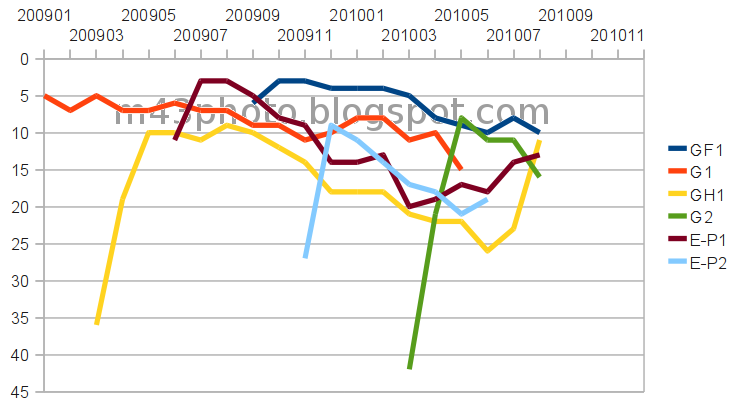
Here is the most recent sales statistics for Micro Four Thirds camera systems. The number in the graph is the ranking the given month. So a "4" means that the specific model was the fourth most sold model during that month. In the first two places you typically find the basic kit models from Nikon and Canon.
There are a lot of interesting findings here. For example, two Panasonic models have had a second birth: Both the GF1 and GH1 have seen an increase of sales, probably due to the discounted prices awaiting the arrival of the newer models GF2 and GH2. This also applies to the Olympus E-P1 camera, which saw a significant sales increase in the third quarter of 2010.
Another finding is that while the Panasonic Lumix G1 sold pretty stably, it was the Olympus E-P1 which made a big difference in the Japanese market. This is consistent with what I saw in the Nordic market. Even though the G1 has, in my opinion, better photographic functionality, it was the E-P1, with the retro styling, and somewhat slimmer body, which got the landslide sales. The E-P2 never was a big seller, it seems.
In the mean time, some competitors have also launched systems. I was not able to find statistics for the Samsung NX system, but the Sony NEX was easy to find. In the diagram below, it is apparent that the Sony NEX was a big hit in Japan.
The top model Sony NEX 5 got an impressive second place in June 2010, and retained the third place in July and August.
Sunday, 7 March 2010
Canon ion 251 review, part 4 (picture quality)
Here are some example images:
The concluding remark must be that this camera is not recommended. It shows that the consumer digital cameras have come a long way during the last twenty years.
Another remark is that this is not really a digital camera at all. The CCD captures analogue images, and the images are stored on analogue magnetic disks. The image is probably never converted to digital inside the camera at all.
Go back to part 3, in use
Go back to part 2, the camera
Go back to part 1, the contents
Canon ion 251 review, part 3 (in use)
Sadly, the rechargeable battery did not function, so I was limited to using the wired battery eliminator, which limited my testing of the camera.
Taking pictures
The following video sequence shows the camera being turned on to "REC" mode. This triggers the camera to count through the 50 frames on the disk backwards, to find the first vacant spot. Having found this, the camera is ready for taking pictures.
When depressing the release shutter half way, the disk starts spinning, getting ready to record your image. Pressing it fully, triggers the shutter and records the image.
The "Mode" button cycles through "Single", "Contionous", and "Self timer".
There is not autofocus at all, you'll just have to hope that the subject is reasonably in focus.
In the viewfinder, there is very little information. There is a flash ready LED indicator, and when using the macro mode, there is a small, red parallax correction tab on the right hand side of the viewfinder.
Showing pictures on a monitor
The camera has no picture display at all. To view the pictures you have taken, you need to connect the camera to a TV set, or, as in my case, to a computer monitor. The camera is connected to the Composite Video input on the monitor.
After putting the camera in "PLAY" mode, you can use the arrow buttons to flip through the 50 images on the disk. In this mode, you can also erase individual images.
>>>Go to part 4, image quality
Go back to part 2, the camera
Go back to part 1, the contents
Saturday, 6 March 2010
Canon ion 251 review, part 2 (the camera)
The left of the two slider switches is also used as the main power button: "Lock" turns the camera off. "Play" is used to display pictures across the video output, while "Rec" is the picture taking mode.
The other slider switch is used to select the flash mode. Finally, there is the yellow shutter release button, and on the far right side of the lens is a macro selector.
The following picture shows the disk drive door open, with a grey two inch video floppy visible.
>>>Go to part 3, in use
Go back to part 1, the contents
Canon ion 251 review, part 1 (the contents)
This was not marketed as a "digital camera", but rather as a "still video camera", which makes more sense, since it is built around a video camera CCD.
In the first part of the review, let's take a look at what's in the package. The camera came with a practical carrying case.
The reverse side of the carrying case has a zipped flap covering accessories, mainly the charger and some cables.
All the contents laid out: The camera inside the protective case, a rechargeable lead acid battery, TV signal converter, battery charger, with an attached battery eliminator.
>>>Go to part 2, the camera
Friday, 1 January 2010
Market shares in Japan
The Japan market shares are usually published every year. The figures comprise system camera units sold in Japan, mostly DSLRs, but the new Micro Four Thirds cameras are included as well. Only the 20 camera models with the largest sold volumes are included in the statistics. Other camera models, with less sales than these, are in the "Others" category.
I have concatenated the 2009 statistics (as at Dec 23rd) with the 2008 statistics, to be able to see the development better:

To make it easier to digest, I have split the figures into camera systems:

Before starting to comment on these figures, it is useful to note that the "Others" category is larger in 2009. This means that the volume of the smallest camera models has increased. We don't know how large the volume of various camera systems are here, but it is reasonable to guess that we would find some more Olympus, Sony and Nikon models in the 2009 "Others" category.
Canon has held their market share remarkably well. It is also worth noting that the full frame camera Canon 5D Mark II has a fairly high market share at 2.1%.
Nikon appears to have lost significant market shares, which must be very bad news for them. On the other hand, it is reasonable to guess that they have somewhat more volume in the "Others" category in 2009, with, e.g., the Nikon D300 and Nikon D700.
Sony must also be very disappointed, with less than 50% of the 2008 market shares. Again, though, they probably have more camera models in "Others" in 2009.
Pentax have succeeded with their strategy of launching entry models packed with features.
Olympus have only got one Four Thirds model in the 2009 list of the twenty most sold camera models, compared with three in the 2008 list. On the other hand, the E-P1 camera has been very popular, and made up for the lost Four Thirds units.
The Micro Four Thirds system has a total of 11.5% of the new sales in Japan in 2009, which I think is very remarkable. After all, the system was launched in 2008, and only two small players in the system camera market are behind it.
2007
For the fiscal year 2007 (actually only January through November), I could only find DSLR sales in summary form: Nikon 43.3%, Canon 39.9% and Pentax 6.3%, with the other producers being smaller.
2006
This table contains DSLR market shares in Japan by December 2006, for the largest ten camera models. I find it hard to believe that the D40 has already captured 15.5% of the total market in December 2006, since it was introduced the same month. However, this table might have been adjusted for the introduction time of each model.

Summary 2006-2009
All of this information can be summarized into one table, but please be aware that the numbers are not entirely comparable from year to year. Still, there is a trend to be seen.

2005-2009 from another source
BCNranking has published statistics for the three most sold brands within interchangeable lens cameras, meaning DSLRs and hybrid systems like Micro Four Thirds. This table shows the same trend as the other material:

We can see that while Canon has had a stable marked share the most recent years, they have actually had a significant decline when looking back five years. Also, Nikon had a good period around 2007, probably due to the launch of D40, but has not been able to sustain the growth.
Panasonic is the big surprise in 2009, with a third place due to the Micro Four Thirds bodies, probably mostly the G1, having been on the market for the whole 2009.
Friday, 25 December 2009
Lumix G HD 14-140mm f/4-5.8 zoom lens
It is only natural that the Panasonic Lumix 14-140mm zoom lens is associated with the Panasonic Lumix GH1 camera: They were both only available as a kit for the first months following the launch in spring 2009. It was only after some time that the lens could be bought alone. From January 2010, the GH1 can be purchased as body only in the UK.The lens has a 10x zoom ratio, and falls into the superzoom category. As is common for lenses of this type, it has a wide angle 28mm starting point (in 35mm camera equivalent terms), and goes all the way up to 280mm, which can be considered as a long telephoto lens.
This long zoom range comes at the cost of an aperture range which is not as impressive: f/4 at the wide angle, and f/5.8 at the long end.
One of the benefits of the Micro Four Thirds system is the compact size, and this benefit seems to be negated by the size of this lens. Even attaching it to the Panasonic GF1, the smallest M43 camera at the time of writing, gives a rather large and bulky package.
Since writing this, the lens has been superseded by the Lumix G HD 14-140mm f/3.5-5.6, which is smaller, lighter, and better in almost any way. I would certainly recommend that you consider the newer lens over the old one.
Aperture range
When looking at the aperture range of zoom lenses, it is common to observe the apertures of the end points. The aperture range, however, is far from linear. It increases faster than you might expect. The diagram below illustrates the aperture at various focal lengths (at 35mm camera equivalent) for the Lumix 14-140mm (blue) and the Nikon 18-200mm (red). As you can see, the Lumix lens has the smallest aperture range of the two, which we already knew, but in addition, the aperture closes down faster as the focal range increases, compared with the Nikon lens.

The 14-140mm lens has been criticized of being overly expensive, compared with similar lenses on the market. For example, the AF-S Zoom-Nikkor ED 18-200mm f/3.5-5.6G IF DX VR, with an 11% longer zoom range, half a stop larger aperture in the wide end, and is less expensive. Canon has also got a lens with the same specifications as the Nikon, and at an even more attractive price point.
Some answers to these comments have been that the 14-140mm has some unique features not found on other lenses: It is optimized for video recording, and features low noise fast autofocus, and an aperture that can change almost steplessly (at 1/6 stop intervals), and almost inaudibly. The aperture is also marketed as being very precise. Another advantage compared with the Nikon and Canon lenses is that it is more compact, at about 15% shorter at the wide angle setting.
Bokeh
I have compared the bokeh of the lens with the Lumix 20mm f/1.7 pancake lens, with the 45mm f/2.8 macro and the 45-200mm f/4-5.6 zoom lenses and the Lumix 14mm f/2.5 lens. It is fair to say that the bokeh of the 14-140mm superzoom lens is not the best. It is a bit "dirty" and features some ringing. However, with the limited maximum aperture, you're not likely to see much out of focus rendering anyway, so this is not a problem. The 14-140mm zoom lens is also more prone to flare, probably due to the complicated construction featuring 17 lens elements in 13 groups.
Sharpness
When using this lens on the Lumix GH1 camera in auto mode, the camera will almost always choose the largest aperture. The exception is outdoors photography in generous sunshine at wide angle. It is good then, that the lens is pretty sharp from the fastest aperture over most of the zoom range. There is little need to stop down, unless you need a very sharp image.
The images are somewhat soft at full aperture in the telephoto focal lengths, though. However, there is seldom room for stopping down the aperture further when photographing at full tele extension, as the shutter speeds tend to be on the slower side already. If you're using a tripod, and are photographing non-moving subjects, you could benefit from using a somewhat smaller aperture.
Here is a sharpness comparison with four other lenses at 140mm. This lens does not perform the best here, and, generally, the newer Lumix G HD 14-140mm f/3.5-5.6 is better.
Here is an example image taken at full tele, 140mm. I used f/5.8, ISO 320, 1/200 second handheld. The picture features the author Erlend Loe.

Here is an example video recording, filmed handheld, at f=108mm (216mm film equivalent), 1/100 second shutter speed, f/5.8, ISO 400.