Introduction

This blog is a user's perspective on the Micro Four Thirds camera system. Read more ...

Lens Buyer's Guide. Panasonic GH4 review.

My lens reviews: Olympus 9mm f/8 fisheye, Lumix G 12-32mm f/3.5-5.6, Leica 25mm f/1.4, Lumix X 12-35mm f/2.8, Lumix X 35-100mm f/2.8, Sigma 30mm f/2.8, Sigma 19mm f/2.8, Lumix X PZ 14-42mm f/3.5-5.6, Lumix X PZ 45-175mm f/4-5.6, Olympus M.Zuiko 45mm f/1.8, Panasonic Lumix G 100-300mm f/4-5.6, Panasonic Leica Lumix DG Macro-Elmarit 45mm f/2.8 1:1 Macro, Panasonic Lumix G 45-200mm f/4-5.6, Panasonic Lumix G 20mm f/1.7 pancake, Panasonic Lumix G 14mm f/2.5 pancake, Panasonic Lumix G HD 14-140mm f/4-5.8, Panasonic Lumix G HD 14-140mm f/3.5-5.6, Panasonic Lumix G 8mm f/3.5 fisheye, Lumix G 7-14mm f/4, Samyang 7.5mm f/3.5 fisheye, Tokina 300mm f/6.3 mirror reflex tele, Lensbaby 5.8mm f/3.5 circular fisheye lens
The blog contains affiliate links. As an Amazon Associate I earn from qualifying purchases.
Showing posts with label bokeh. Show all posts

Friday, 14 March 2014

Comparison @ 60mm

These are two of the most highly regarded lenses in the Micro Four Thirds lineup: The Sigma 60mm f/2.8 DN (left) and Lumix X 35-100mm f/2.8 (right):


The Sigma 60mm f/2.8 DN is a quite recent lens in their "Art line". Corresponding to a field of view of 120mm on a traditional film camera, it is a fairly long lens, slightly longer than the typical portrait lens. People often use it to take portraits, and for images of people from about 2-4 meter distance.

Sunday, 22 September 2013

Bokeh part 2

I previously wrote about bokeh, describing what it means (the nature of the rendering of out of focus areas), how it is commonly used, and I also looked into how the aperture setting affects the out of focus areas in the picture.

This time, I want to look more closely at how the bokeh differs by lenses. I've tested some common fast lenses from the Micro Four Thirds lens lineup, laid out here:


Second row: Olympus 45mm f/1.8, Leica Lumix 45mm f/2.8 macro, Lumix X 12-35mm f/2.8
First row: Lumix G 14mm f/2.5, Lumix G 20mm f/1.7, Sigma 30mm f/2.8 DN and Sigma 19mm f/2.8 DN

Thursday, 7 February 2013

Bokeh comparison @ 20mm and 19mm

The Sigma 19mm f/2.8 EX DN lens can be an interesting alternative to the Lumix G 20mm f/1.7. It focuses significantly faster for both stills and movies, and while it is not as sharp as the 20mm lens, it is still sharp enough. It also comes at a much lower price.


In this article, I'm looking at the out of focus rendering of the lenses, the bokeh. I also threw the Lumix X 12-35mm f/2.8 into the comparison.

The comparison was done by focusing on a close object, the box at about 50cm distance in the left foreground:

Sigma 19mm @ f/2.8 Lumix G 20mm @ f/2.8 Lumix X 12-35mm @ f/2.8

Here are some 100% crops from the centre:


And from the extreme right border:


The Lumix G 20mm f/1.7 features asymmetrical out-of-focus rendering outside of the centre of the frame: The further from the centre, the more elliptical the bokeh highlights become. You can see the same phenomenon in this study. This property is also shared with the Lumix-Leica 45mm f/2.8 1:1 macro lens.

The Lumix X 12-35mm f/2.8 also has some minor disturbance in the border: The out-of-focus highlights are rendered somewhat non-circular. When stopping down, this becomes less of a problem. However, this is a very minor issue.

Overall, I think the Sigma 19mm f/2.8 EX DN probably has the most pleasing out of focus rendering in this high contrast scene.


Wednesday, 2 January 2013

Lumix X 12-35mm f/2.8 review

The Panasonic Lumix X 12-35mm f/2.8 is a premium standard zoom lens. It was released in 2012, but obviously intended as the kit lens for the high end GH3 camera released later the same year. The lens is show below, together the with basic Lumix G 14-42mm f/3.5-5.6 kit zoom lens:


Wednesday, 26 December 2012

Lumix X 12-35mm f/2.8 sharpness evaluation

The Lumix X 12-35mm f/2.8 is the new premium standard zoom lens from Panasonic. It was launched before the Panasonic GH3 camera, but obviously intended as the kit lens for their highest quality cameras. With a steep price tag to boot, there is much anticipation to the image quality from this lens.


A viewpoint commonly found in online discussions is that a prime lens is always better than a zoom lens. With this in mind, it is sensible to compare this zoom lens with some prime lenses. I chose to compare it with the Lumix G 14mm f/2.5 pancake lens and the Sigma 30mm f/2.8 EX DN, which are both covered by the zoom range of the Lumix X 12-35mm lens.

At 14mm


Using a tripod, and with the GH3 camera at the base ISO 200, I took the same picture with both lenses. The focus distance was very short, about 30cm/one foot. The pictures are out of camera (OOC) JPEGs. I made sure to focus on the same item in both images, the lone branch in the upper left corner.

Lumix G 12-35mm @ 14mm f/2.8Lumix G 14mm @ f/2.5

Now, let me be the first to admit that there are many problems with this test setup. For example, the lenses have different lengths, so that the field of view turns out to be different in the two cases, even though the camera is at exactly the same place in both examples.

Also, since I am focusing on an item close to the border of the frame, what is in focus could be quite different in the centre of the frame, due to different focal plane curvature. However, despite these shortcomings, I think we will be able to see examples of items that are in focus in both pictures, and, hence, be able to do some comparison of their relative sharpness.

Here are some enlargements (100% crops) from the top left corner, where I set the focus point.


And from the top middle:


Finally, from the centre:


Based on these images, keeping in mind that the focal plane may be slightly different in the two last crops, I think we can conclude that they are pretty much equally sharp.

The Lumix X 12-35mm zoom lens appears to give a bit nicer bokeh, but on the other hand, the Lumix G 14mm f/2.5 handles the flare better. These observations are perhaps not surprising: We already know that the pancake lenses are not optimal in terms of bokeh. And when it comes to flare, we would normally expect that the simpler lens, with fewer lens elements, handles flare the best. The Lumix G 14mm pancake lens has only six lens elements, while the zoom lens has a whopping 14 lens elements. Flare is usually caused by unwanted stray reflection and refraction between the lens elements.

I think we can conclude that both lenses perform very well here.

At 30mm


This time, I focused in the single leaf in the centre of the frame. The focus distance was about one meter (three feet), suitable for a portrait photo.


Lumix G 12-35mm @ 30mm f/2.8Sigma 30mm @ f/2.8

While I thought that I focused on a single leaf in the centre, it turns out that they were two different leaves, at some distance, and the Sigma lens focused on the left leaf, while the Lumix lens focused on the right leaf.This just shows that extreme caution must be taken when doing these studies. Still, I think the 100% crops from the centre are interesting:


We see that both lenses are very sharp in the centre. We also see that the Sigma 30mm lens is more resistant to flare, again probably because of the simpler construction using only seven lens elements.

Here are some crops from the lower left side, to look at the bokeh:


Based on these examples, the bokeh looks just fine for both lenses.

Conclusion


My experience so far indicates that the Lumix X 12-35mm f/2.8 zoom lens has very good optical properties. I plan to make more comparisons later.

Despite using "nano surface coatings", the lens is prone to flare, though, but it is not unexpected for a lens of this class.

Friday, 3 August 2012

Bokeh comparison

With kit zoom lenses, the bokeh, the rendering of out of focus areas, is not too important. This is because they feature a small maximum aperture, leaving quite a lot in focus anyway. So that the rendering of out of focus objects is less of an issue, with most of the image in focus.

When using prime lenses with a larger maximum aperture, though, the bokeh becomes more important. With a larger aperture, you're more likely to find the background or foreground out of focus, and the quality of this rendering matters.

I've looked a three common prime lenses. The Lumix G 20mm f/1.7, the Sigma 30mm f/2.8, and the Olympus 45mm f/1.8. Out of these three, the Sigma lens is the odd man out, with a not too impressive max aperture of f/2.8. On the other hand, it is also the cheaper of the three lenses.


From my previous experiments, I know that both the 20mm lens and the 45mm lens have quite ok bokeh. The 20mm lens can give out of focus highlights that are elliptically shaped outside the centre of the frame. The 45mm lens is pretty much unproblematic. But the 30mm lens is a bit of an unknown to me at this time.


First test

My first comparison is done in the morning, with a low sun behind some foliage. I focused on the LEGO figure in the centre. I moved closer with shorter lenses, so that the LEGO figure fills out about the same space in the frame. The distance is about 0.9m with the longest lens, and around 0.4m. The distance is slightly shorter than what you would use when photographing the head of a person, given the same lens.

This situation will typically reveal lenses that render the out of focus background in a "busy" way. Ideally, we'd like to see the lenses blur the background so that it does not distract the viewer from the main subject.

Here are the full images, with all three lenses. They are all taken using a tripod, at ISO 160 on a GH2, and the exposures are generally between 1/60s and 1/5s. I used autofocus, and set a small centre spot area. Click for larger images:

Lumix G 20mm f/1.7 Sigma 30mm f/2.8 Olympus 45mm f/1.8

To look at how the centre, which was intended to be in focus, was rendered, here are some 100% crops from the centre area:


And from the top right corner:


Second test

My first comparison is done at night time, with high contrasts. I have focused on the basket of a bicycle, and there are some lights in the background. With the shorter focal length, I moved closer to the basket, so that the framing is pretty much the same. The distance is about what you would use when photographing the head of a person, given the same lens.

Here are the full images, with all three lenses. They are all taken using a tripod, at ISO 160 on a GH2, and the exposures are generally between 1/2s and 4s. I used autofocus, and set a small centre spot area. Click for larger images:

Lumix G 20mm f/1.7 Sigma 30mm f/2.8 Olympus 45mm f/1.8

To look at how the centre, which was intended to be in focus, was rendered, here are some 100% crops from the centre area:


I wouldn't use these to evaluate the sharpness, as I am not 100% sure that the camera focused at the very centre each time.

And a look at the out of focus rendering of the background highlight:


Conclusion

This comparison shows us that the bokeh of all these lenses is quite good. The Lumix G 20mm f/1.7 has elliptical out of focus highlights outside of the centre, as we have seen previously.

On the other hand, both the Sigma 30mm f/2.8 and the Olympus 45mm f/1.8 display slightly "busy" out of focus rendering when wide open. These two lenses could have blurred the background in a more pleasing way, but this is not a big deal. I don't think the background is very distracting in my test.

My perception is also that the Sigma 30mm f/2.8 lens handles high contrast situations the best. It appears to retain the contrast well, and flare/ghosting is not a problem. For a night exposure, I would use this lens when possible. This property may be due to the relatively simple construction of the 30mm lens: It does not have a large maximum aperture, not a wide angle, and is not a pancake. Hence, the optical construction is more trivial.

Another conclusion to be made, is that a longer lens gives more out of focus images, given the same framing and aperture. If you're after this effect in your images, it may pay to look for lenses that are long.


Thursday, 27 October 2011

Olympus vs Panasonic @ 45mm

The long awaited portrait prime lens for Micro Four Thirds is finally here. Olympus has launched their M.Zuiko Digital 45mm f/1.8 lens. It is compact, fairly light, relatively cheap, and focuses quickly and noiselessly.

Before this lens was available, the closest we had to a portrait lens for the Micro Four Thirds format was the Panasonic Leica 45mm f/2.8 macro lens. While this lens is a good macro lens, it has not been very well received as a portrait lens because of the not so impressive f/2.8 maximum aperture.


Panasonic 45mm f/2.8 macro (left), Olympus 45mm f/1.8 (right)

How do these lenses compare when it comes to sharpness? I have made some tests to find out. The images were shot using the Panasonic GH2 camera, at base ISO 160, on a sturdy tripod, and with OIS turned off for the Panasonic lens. The Olympus lens does not feature any OIS.


Infinity focus

These images were taken at a focus distance of around infinity. The sun is in the upper left corner of the image frame, which makes for a challenging situation for any lens. A strong light source in the image frame can easily lead to flare, loss of contrast and chromatic aberration (CA) artifacts.


PL45 @ f/2.8
Olympus 45 @ f/1.8

Let's take a closer look at some 100% crops from various parts of the image frame. Here's from the centre:


And from the upper left corner, where the contrast is the largest:


And finally from the top right corner:


10m focus

These next set of images were taken at a focus distance of about 10m. These images were rescaled and sharpened. You can click on the images to see them in a larger size.


PL45 @ f/2.8
Olympus 45 @ f/1.8

For better evaluation of the sharpness, I have made crops from the centre of the image. These crops are taken at 100% magnification, meaning that one pixel in the image corresponds to one pixel from the camera. Click for an enlargement:


And here are similar crops from the extreme top right corner:


0.7m focus

And to complete the review, I have also compared the sharpness at a closer focus distance. In this case, the focus is placed on the centre of the ball, which is at approximately 0.7m distance (about two feet). A portrait distance is typically at 1m or more.


PL45 @ f/2.8
Olympus 45 @ f/1.8

And the crops from the centre:


To evaluate the sharpness based on these is probably not so easy. But the image series can be used to look at the out of focus rendering (bokeh):


Just to satisfy my curiosity, I also took these images at f/16. Due to diffraction, you would normally not use such a small aperture, since it will lead to some dullness at pixel level. But if you need a deep depth of focus, and are planning to publish the image on the web, I would say that it could be a reasonable balance between DOF and image quality to use f/16.


Night scene

Here is a night scene. The focus is set on the middle of the branch:


PL45 @ f/2.8
Olympus 45 @ f/1.8

Some closeups of the out of focus rendering of highlight on the top, right corner:


And from the left side:


Conclusion

So, which lens is best in terms of sharpness? I think that the Panasonic lens generally does better. The Panasonic lens appears to render a bit better at f/2.8, in my opinion. At larger apertures, there is no comparison, of course, since the Panasonic lens cannot be opened further.

The Olympus lens does exhibit quite a bit of dullness at f/1.8 and f/2. On the other hand, it could be that the DOF is too thin for this comparison, even at a focus distance of 10m. So the subject for this comparison was perhaps not entirely perfect.

At the largest apertures, the Olympus lens does show some chromatic aberration (CA) artifacts, both in the centre and in the corner. You can see that near objects have a purple outline, while far objects have a green outline. This is quite common, and can be seen also for the older Olympus Zuiko Digital 50mm f/2 macro lens. When stopped down to f/2.8, CA artifacts are no longer a problem.

The Panasonic lens does not exhibit any significant CA artifacts. Perhaps this is because the CA artifacts are removed in software post processing? I have tried to examine this by looking at uncorrected RAW images and JPEG images, and concluded that there are probably no software correction with the PL45.

I think it looks like flare affects the Panasonic lens the most. This is not surprising, since flare is generally a larger problem the more lens surfaces the light passes through. And the Panasonic lens has the most complicated optical design, with 14 lens elements in ten groups, while the Olympus lens has nine lens elements in eight groups.

The Olympus lens does not exhibit much vignetting. The Panasonic lens, on the other hand, has a bit of vignetting wide open, which goes away at f/4. Again, this could be due to software correction to the Olympus lens, I don't know.

The bokeh appears to be effective smoothing the background, but my daylight example image was not very challenging for the lenses. With higher contrast, at night, the out of focus rendering is not perfect for either lens. The discs are non round off-center for the Panasonic lens: They are elliptical when the lens is wide open. The Olympus lens gives pretty round discs wide open, but they have a tad bit more tacky edges when stopped down, due to the aperture blades not being as rounded.

The Olympus lens is cheaper and faster than the Panasonic lens. But the larger aperture comes at the expense of worse image quality wide open. At f/2.8, they are pretty comparable, but the Panasonic lens perhaps has the upper hand by a small margin. Despite these findings, the Olympus lens does appear to give a good value for money. For users looking for a portrait lens, or a moderately long and fast prime, this is the only choice at the moment.

I have also compared the PL45 with the Nikon Z 105mm f/2.8 for the Nikon Z system. It very apparent in this review that the Nikon lens is way better.


Saturday, 22 October 2011

Bokeh comparison @ 200mm and 300mm

I like the long tele zoom Panasonic Lumix G 100-300mm f/4-5.6. It is unexpectedly sharp, considering the price, and generally fun to use.

However, after some use, I see some examples where the background blur is a bit distracting. The bokeh some times exhibit a bit of ringing, which means that it doesn't blur the background as effectively as one could wish for.

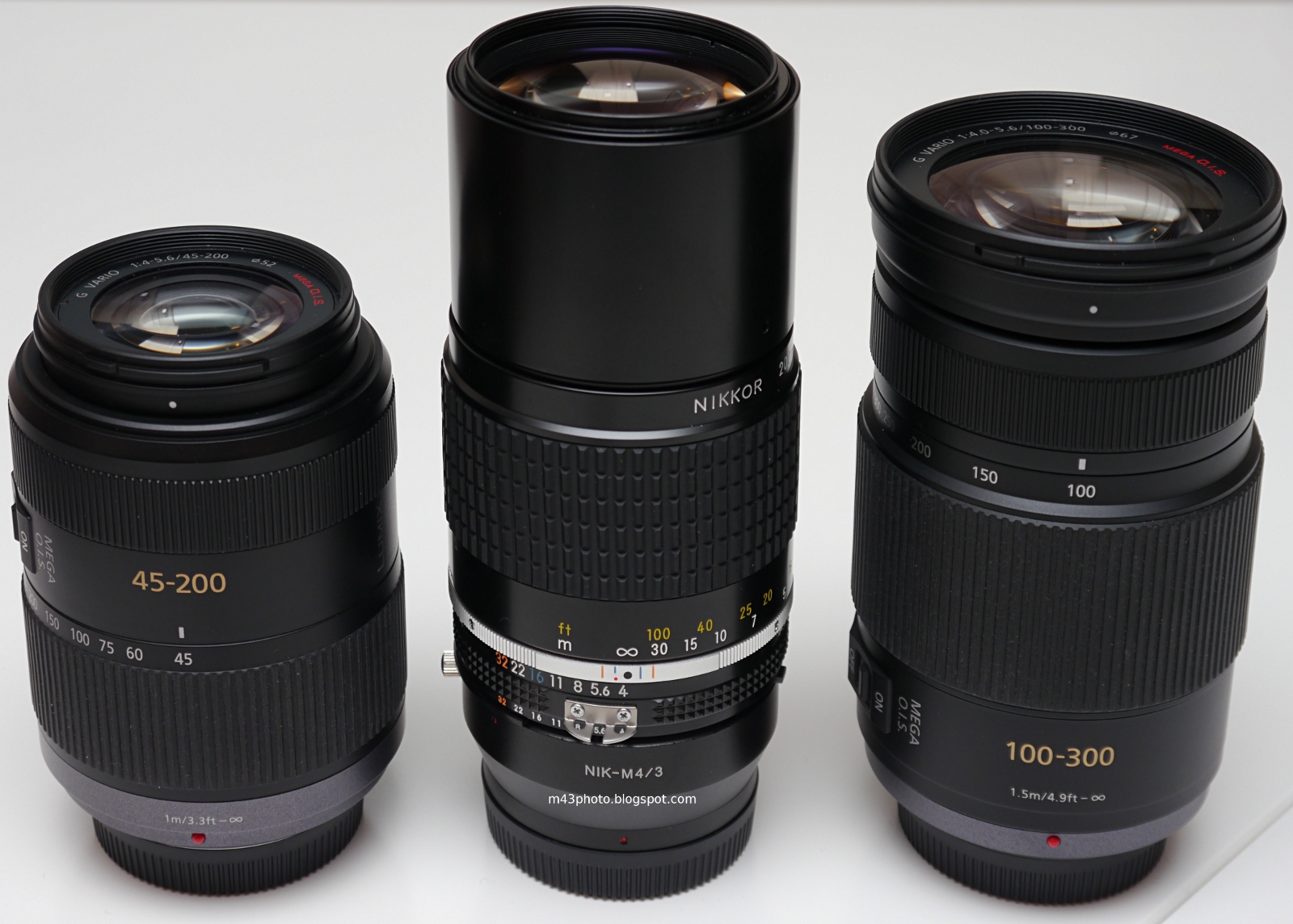
I decided to test the bokeh with some out of focus highlights. To do this, I photographed the same subject using three lenses, the Panasonic Lumix G 100-300mm f/4-5.6, Nikkor 200mm f/4 AIS, and Panasonic Lumix G 45-200mm f/4-5.6. The three lenses are shown below:


The Nikkor 200mm f/4 AIS lens in the centre is shown including the adapter needed to connect it to a Micro Four Thirds camera.

@ 200mm

The images were taken at dusk, with the camera on a sturdy tripod, and focused on the tree about 2 meters from the camera. I used ISO 160, the base ISO for the Panasonic GH2 camera. As I took the images late dusk, the lightning changed quickly, and they may have different exposure.

Here are the images, click to enlarge:


Lumix G 45-200mm @ 200mm f/5.6

Nikkor 200mm f/4

Lumix G 100-300mm @ 200mm f/4.9

I have made some enlargements as well. These are 100% crops from the centre of the images.


Bokeh

Based on this study, I cannot see any problems with the bokeh of these lenses. They all look just fine. One problem with the Nikkor 200mm f/4 AIS lens, though, is that the aperture diaphragm blades are not rounded. Hence, when stopping down, the lens gives nine-sided out of focus discs, they don't have a rounded edge:


Sharpness

When it comes to the sharpness, the crops above are not suited for comparing the sharpness across the lenses. The Lumix lenses support autofocus, of course, and after viewing the images on PC, I noticed that the camera has prioritized to get the edge of the tree in focus. When focusing the Nikkor 200mm lens manually, I focused on the centre of the branch. So they are not comparable. However, after looking at the images, my conclusion is the same as before: The Panasonic Lumix G 100-300mm f/4-5.6 is significantly sharper than the Panasonic Lumix G 45-200mm f/4-5.6 at 200mm. The Nikkor 200mm f/4 lens appears to sit between them, in terms of sharpness.

@ 300mm

The Panasonic Lumix G 100-300mm f/4-5.6 is my only lens capable of doing 300mm focal length. So I don't have anything to compare with. But here are a couple of images taken at 300mm f/5.6 and f/8:


Again, the bokeh looks just fine, no perceived problems here.

Conclusion

While I believe the Panasonic Lumix G 100-300mm f/4-5.6 is prone to giving slightly distracting bokeh in certain cases, I could not reveal any in this simple test.

We see clearly that the Nikkor 200mm f/4 AIS lens has non-circular out of focus rendering when stopped down, due to non-rounded aperture diaphragm blades. This is not so good for the resulting pictures.

I think that this simple test illustrates another example that legacy lenses are not perfect for use on modern cameras. While the lens is reasonably good in terms of sharpness, the primitive aperture makes it problematic when stopped down. In a previous study, I saw that the Pentax FA50 f/1.4 normal lens exhibits quite distracting bokeh between f/1.4 and f/2. The whole point of getting a fast legacy normal lens is to use it pretty much wide open, and that example shows that it can be non-optimal for such use.

So take care if you buy older manual lenses for use on Micro Four Thirds: Do some pre purchase research to make sure the lens fits your needs.