Introduction

This blog is a user's perspective on the Micro Four Thirds camera system. Read more ...

Lens Buyer's Guide. Panasonic GH4 review.

My lens reviews: Olympus 9mm f/8 fisheye, Lumix G 12-32mm f/3.5-5.6, Leica 25mm f/1.4, Lumix X 12-35mm f/2.8, Lumix X 35-100mm f/2.8, Sigma 30mm f/2.8, Sigma 19mm f/2.8, Lumix X PZ 14-42mm f/3.5-5.6, Lumix X PZ 45-175mm f/4-5.6, Olympus M.Zuiko 45mm f/1.8, Panasonic Lumix G 100-300mm f/4-5.6, Panasonic Leica Lumix DG Macro-Elmarit 45mm f/2.8 1:1 Macro, Panasonic Lumix G 45-200mm f/4-5.6, Panasonic Lumix G 20mm f/1.7 pancake, Panasonic Lumix G 14mm f/2.5 pancake, Panasonic Lumix G HD 14-140mm f/4-5.8, Panasonic Lumix G HD 14-140mm f/3.5-5.6, Panasonic Lumix G 8mm f/3.5 fisheye, Lumix G 7-14mm f/4, Samyang 7.5mm f/3.5 fisheye, Tokina 300mm f/6.3 mirror reflex tele, Lensbaby 5.8mm f/3.5 circular fisheye lens
The blog contains affiliate links. As an Amazon Associate I earn from qualifying purchases.
Showing posts with label statistics. Show all posts

Thursday, 28 January 2016

Mirrorless sales statistics from Japan

Not much exists in terms of solid statistics on camera sales. However, one yearly event is when BCN Ranking release their statistics for the sales of cameras in Japan. Their statistics cover most of the domestic sales.

The statistics tend to take different forms every year. Some years, they have reported the 20 most sold models, which is quite interesting to see. This year, reporting on 2015 camera sales, it is probably the least useful: Only reporting the market share for the top three brands.

When compiling this into a seven year time series, this is what I get:


As only the top three systems are reported, we only see Olympus, Sony and Canon here. The Panasonic market share is not specified for 2015, but we can deduce that it is at least lower than that of Canon, that is, 13%. The same goes for the other systems.

Panasonic started off very high, which is very understandable, since they were the only mirrorless system in the very beginning. However, they were soon overtaken by Olympus and Sony.

It seems that Olympus have gotten a boost in 2015, which I would attribute to the Olympus OM-D E-M5 Mark II, which is very stylish, and at the same time, offered a very interesting feature set.

Sony, on the other hand, have focused almost exclusively on fullframe mirrorless during 2015. They have launched a number of Sony A7 models. These are very fine cameras, but they are expensive, and require an investment into newer, larger, and more expensive fullframe lenses. Hence, one cannot expect as many camera sales from Sony as before. They probably make a better margin from each camera, though.

We are still waiting for an upgrade of the APS-C mirrorless camera Sony A6000. A replacement camera is rumored to have a high resolution 36MP sensor. If true, this will be a game changer for APS-C sensor based cameras.

What surprises me, is that Canon gets an increase in the market share. They have improved their mirrorless cameras now, but the Canon EOS M3 is still not a very interesting camera. And with the limited palette of lenses, I would personally not have invested into this system today. The positive market development probably says something about Canon's market perception: Very strong.

With Olympus's new retro styled Olympus PEN-F, I expect their market share to remain strong.

Sunday, 13 January 2013

Sales statistics from Japan

BCN Ranking publishes sales statistics for various categories of cameras in Japan. Last year, I made a summary of the system camera category, which includes both mirrorless sytems and DSLRs. We saw that Micro Four Thirds had reached a healthy 19% of this category by the end of 2011:


For the 2012 statistics, BCN Ranking has split these into two categories: DSLRs and mirrorless. This makes sense, of course, but the downside is that I cannot continue my time series of statistics. BCN only give the percentage of sales, not the absolute number, hence I cannot recombine the two categories.

Anyway, let's see what the 2012 statistics for the mirrorless category looks like:


And when summing up per camera system:


Just like the previous statistics, these are based on the twenty most sold camera models. This means that you cannot expect the percentages to add up to 100%. There is still another 9% missing. In the missing category, I would expect that you find cameras like the Panasonic G5 and GH2, among others.

Micro Four Thirds has a very healthy lead in the mirrorless camera category, at 50% market share. I would attribute this to the fact that they launched their system early, and have a lot of quality lenses out.

One could expect to find the Samsung NX system on the list. On the other hand, it is fair to say that there is some rivalry between Samsung, which is a Korean brand, and the other manufacturers on the list, which are Japanese. While Samsung does not sell well in Japan, I think they do better in other markets, like Europe.

The Nikon 1 system is already at a good market share of 13%. They have a very strong brand in Japan, and have invested heavily in marketing. The volume models, the J series, look cute, with various colour schemes, and a clean design with geometric shapes.

The Pentax Q system er quite odd, in my opinion, with a very small sensor size. At this sensor size, I think most people are better off buying a premium compact camera, like the Panasonic LX7 or Olympus XZ-2.

Pentax K-01

The Pentax K-01 is also an odd machine. It shares the lens mount with the Pentax DSLR cameras. Hence, it is a mirrorless camera with the register distance of an SLR. While sharing the lens mount has some advantages, it also means that there is little size advantage to the mirrorless system. Because the camera needs to be as large (except for the pentaprism), and the lenses cannot benefit from a shorter register distance.


Wednesday, 29 December 2010

Yearly sales statistics from Japan

It's time for the yearly sales statistics from Japan (from BCN Ranking). Here's the list of the 20 most sold system camera units, comprising DSLRs and mirrorless interchangeable lens cameras. I have included 2009 and 2008 for reference.


To make the table more readable, I have categorized the cameras into systems. This makes the following table, with slightly different principles going from 2006-2010. However, it still shows some clear trends:


Nikon had a good market penetration with the Nikon D40 back in 2006, however, since that time they have not been able to sustain the market share. These must be depressing statistics for Nikon.

Canon have been successful in the competition against Nikon the last years, however, in 2010 even they have seen a decline in market share. A decline which seems to have gone to the mirrorless cameras: Sony never got their DSRLs into the market as they wanted, but they've seen a much better penetration with the new Sony NEX mirrorless series.

And for the Micro Four Thirds cameras made by Olympus and Panasonic, the growth continues. From the monthly statistics, we can see that the Olympus E-P2 never was a big seller. It's predecessor, the E-P1, is still on the list of the twenty most selling cameras. People appear to prefer the E-PL1 (with built a in flash), or the E-P1 (for a lower price, at the end of it's product cycle).

Pentax are still succeeding well with their strategy of launching feature packed entry models at a reasonable price.

Saturday, 27 November 2010

Camera sales statistics from Japan

Update: There is newer sales data from the end of December 2010 here.

BCN Ranking provides monthly sales statistics for various items in Japan. One of them is system cameras, which includes DSLRs and mirrorless systems.

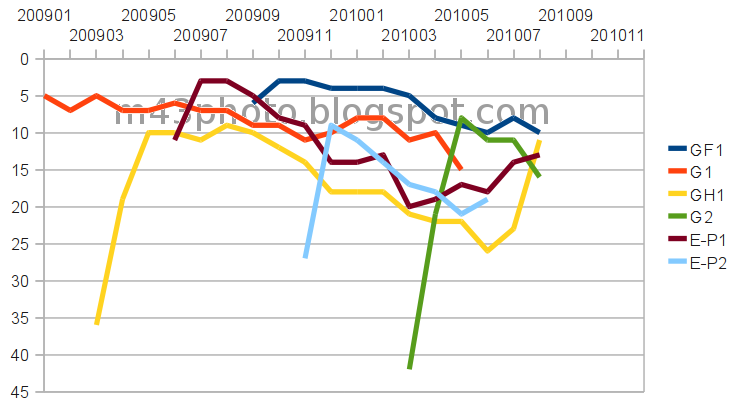
Here is the most recent sales statistics for Micro Four Thirds camera systems. The number in the graph is the ranking the given month. So a "4" means that the specific model was the fourth most sold model during that month. In the first two places you typically find the basic kit models from Nikon and Canon.


There are a lot of interesting findings here.  For example, two Panasonic models have had a second birth: Both the GF1 and GH1 have seen an increase of sales, probably due to the discounted prices awaiting the arrival of the newer models GF2 and GH2.  This also applies to the Olympus E-P1 camera, which saw a significant sales increase in the third quarter of 2010.

Another finding is that while the Panasonic Lumix G1 sold pretty stably, it was the Olympus E-P1 which made a big difference in the Japanese market.  This is consistent with what I saw in the Nordic market.  Even though the G1 has, in my opinion, better photographic functionality, it was the E-P1, with the retro styling, and somewhat slimmer body, which got the landslide sales.  The E-P2 never was a big seller, it seems.

In the mean time, some competitors have also launched systems. I was not able to find statistics for the Samsung NX system, but the Sony NEX was easy to find.  In the diagram below, it is apparent that the Sony NEX was a big hit in Japan.


The top model Sony NEX 5 got an impressive second place in June 2010, and retained the third place in July and August.

Friday, 1 January 2010

Market shares in Japan

Update: I have compiled newer statistics based on 2010, which supersede this material.

The Japan market shares are usually published every year. The figures comprise system camera units sold in Japan, mostly DSLRs, but the new Micro Four Thirds cameras are included as well. Only the 20 camera models with the largest sold volumes are included in the statistics. Other camera models, with less sales than these, are in the "Others" category.

I have concatenated the 2009 statistics (as at Dec 23rd) with the 2008 statistics, to be able to see the development better:


To make it easier to digest, I have split the figures into camera systems:


Before starting to comment on these figures, it is useful to note that the "Others" category is larger in 2009. This means that the volume of the smallest camera models has increased. We don't know how large the volume of various camera systems are here, but it is reasonable to guess that we would find some more Olympus, Sony and Nikon models in the 2009 "Others" category.

Canon has held their market share remarkably well. It is also worth noting that the full frame camera Canon 5D Mark II has a fairly high market share at 2.1%.

Nikon appears to have lost significant market shares, which must be very bad news for them. On the other hand, it is reasonable to guess that they have somewhat more volume in the "Others" category in 2009, with, e.g., the Nikon D300 and Nikon D700.

Sony must also be very disappointed, with less than 50% of the 2008 market shares. Again, though, they probably have more camera models in "Others" in 2009.

Pentax have succeeded with their strategy of launching entry models packed with features.

Olympus have only got one Four Thirds model in the 2009 list of the twenty most sold camera models, compared with three in the 2008 list. On the other hand, the E-P1 camera has been very popular, and made up for the lost Four Thirds units.

The Micro Four Thirds system has a total of 11.5% of the new sales in Japan in 2009, which I think is very remarkable. After all, the system was launched in 2008, and only two small players in the system camera market are behind it.

2007

For the fiscal year 2007 (actually only January through November), I could only find DSLR sales in summary form: Nikon 43.3%, Canon 39.9% and Pentax 6.3%, with the other producers being smaller.

2006

This table contains DSLR market shares in Japan by December 2006, for the largest ten camera models. I find it hard to believe that the D40 has already captured 15.5% of the total market in December 2006, since it was introduced the same month. However, this table might have been adjusted for the introduction time of each model.


Summary 2006-2009

All of this information can be summarized into one table, but please be aware that the numbers are not entirely comparable from year to year. Still, there is a trend to be seen.


2005-2009 from another source

BCNranking has published statistics for the three most sold brands within interchangeable lens cameras, meaning DSLRs and hybrid systems like Micro Four Thirds. This table shows the same trend as the other material:


We can see that while Canon has had a stable marked share the most recent years, they have actually had a significant decline when looking back five years. Also, Nikon had a good period around 2007, probably due to the launch of D40, but has not been able to sustain the growth.

Panasonic is the big surprise in 2009, with a third place due to the Micro Four Thirds bodies, probably mostly the G1, having been on the market for the whole 2009.