Introduction

This blog is a user's perspective on the Micro Four Thirds camera system. Read more ...

Lens Buyer's Guide. Panasonic GH4 review.

My lens reviews: Olympus 9mm f/8 fisheye, Lumix G 12-32mm f/3.5-5.6, Leica 25mm f/1.4, Lumix X 12-35mm f/2.8, Lumix X 35-100mm f/2.8, Sigma 30mm f/2.8, Sigma 19mm f/2.8, Lumix X PZ 14-42mm f/3.5-5.6, Lumix X PZ 45-175mm f/4-5.6, Olympus M.Zuiko 45mm f/1.8, Panasonic Lumix G 100-300mm f/4-5.6, Panasonic Leica Lumix DG Macro-Elmarit 45mm f/2.8 1:1 Macro, Panasonic Lumix G 45-200mm f/4-5.6, Panasonic Lumix G 20mm f/1.7 pancake, Panasonic Lumix G 14mm f/2.5 pancake, Panasonic Lumix G HD 14-140mm f/4-5.8, Panasonic Lumix G HD 14-140mm f/3.5-5.6, Panasonic Lumix G 8mm f/3.5 fisheye, Lumix G 7-14mm f/4, Samyang 7.5mm f/3.5 fisheye, Tokina 300mm f/6.3 mirror reflex tele, Lensbaby 5.8mm f/3.5 circular fisheye lens
The blog contains affiliate links. As an Amazon Associate I earn from qualifying purchases.

Sunday, 20 November 2011

Olympus 45mm f/1.8 review

The Olympus M.Zuiko Digital 45mm f/1.8 is a much anticipated lens. When it arrived, it closed one of the major gaps in the Micro Four Thirds lens lineup: The portrait prime lens.

Appearance

The lens is fairly compact, with a 37mm front lens thread, and is significantly smaller than the other 45mm prime lens, the Panasonic-Leica 45mm f/2.8 1:1 macro lens. They are shown below:


Saturday, 19 November 2011

GH2, ETC mode for macro video

The Panasonic GH2 has a very interesting feature, the ETC, Extra Tele Conversion mode. This is like a digital tele zoom. However, when used with videos, you still get the full resolution, with the centre of the sensor being used. This drawing illustrates the concept:


With this feature, you can record full HD videos with an effective 2.6x tele effect, with 2.6 being the fraction 2800/1080. Using the ETC mode, the Lumix G 100-300mm f/4-5.6 tele zoom lens gets an effective 1560mm maximum tele reach, in 35mm film camera equivalents.

However, this effect can also be used for even more enlargements when using a macro lens. Using the Panasonic Leica Lumix DG Macro-Elmarit 45mm f/2.8 1:1 macro lens gives you an maximum enlargement of 1:1. Using the ETC mode gives you a maximum of 2.6:1, which is very impressive. Keep in mind, though, that this only makes sense with videos, not with still images.

I have illustrated this effect with a macro video recording of my own eye. The following footage shows the same scene without and with ETC:


It was recorded using the "Manual Movie Mode", 1080p24, f/5.6, 1/25s. To get a sufficient exposure, I used ISO 1600.

As you can see, the depth of focus (DOF) is very thin, and it is difficult to keep my iris in focus. Setting a smaller aperture, e.g., f/8, would help here, but that would require an even higher ISO. And in my experience, there is significantly more noise with ETC mode compared with the ordinary video mode, especially at high ISO.

Saturday, 5 November 2011

Focus speed, PL45 vs MZD45

There are two competing 45mm prime lenses in the Micro Four Thirds lineup. The Panasonic Leica 45mm f/2.8 macro lens and the newer Olympus M.Zuiko Digital 45mm f/1.8 portrait lens. While one is a macro lens, and the other could be categorized as a portrait prime lens, they can of course be used for a wide variety of other tasks.

I have previously compared the sharpness of the two lenses in various settings. While the comparisons are not always optimal, and could even be a tad bit misleading, I think it is clear that the Panasonic lens is a little bit better in terms of sharpness. This is not really surprising, since a large aperture lens contains more optical compromises, and usually cannot have the very best sharpness. As a general rule, one does not buy a large aperture lens for the optimal sharpness, but for using it wide open or near wide open, in which case sharpness is usually not the main concern.

People generally say that the Olympus M.Zuiko Digital 45mm f/1.8 features faster focusing. But is it true? The Olympus lens is rated as Movie-Still-Compatible (MSC), which means that the focus speed should be quite good.

I have compared them head-to-head in the same setup. The Panasonic GH2 camera was set up about 60cm from the subject, and I selected centre spot focus. The Olympus lens has a close focus distance of 50cm, and the Panasonic lens has a selectable focus limiter, which cuts off at around 50cm for better focus speed.

When powering on the camera, the lens is focused around infinity. Upon pressing the shutter release button, the camera focuses, and then takes the picture. I measure the time from the camera notes that the shutter release button is pressed, until the camera is ready to expose the image. The first event can be noted by the number of remaining frames being shown in the lower right part of the LCD display, and the latter by the green dot appearing in the upper right corner of the display.

Light background, daylight

Here is the comparison in daylight, the lightning was about EV7.


The focus speeds are rather similar:

PL45, focus delimiter off: 0.32s

PL45, focus delimiter on: 0.32s

MZD45: 0.26s

Dark background, dark room

And another test at EV2, which is very dark:


In this test, the Panasonic-Leica lens focuses faster:

PL45, focus delimiter off: 0.68s

PL45, focus delimiter on: 0.66s

MZD45: 1.12s and 1.08s (two tests)

Conclusion

lightdark
PL45, limiter off0.32s0.68s
PL45, limiter on0.32s0.66s
MZD450.26s1.08s, 1.12s

As people have been saying, the Olympus M.Zuiko Digital 45mm f/1.8 lens is indeed faster in terms of autofocus. But only by a small margin. And in dark conditions, to my surprise I found that the Panasonic-Leica 45mm f/2.8 lens focused faster.

This is just some few simple measurement, and in practical use, the experience might be different. During the time I have used both, I have generally found that the autofocus speed is comparable between them for practical, daily use.

Generally, the speed readings here are quite good. I have previously seen that the Panasonic kit zoom lenses achieve focus speeds of around 0.17s to 0.33s under similar conditions. But keep in mind that a much higher degree of focus accuracy is needed for a large aperture lens at f/1.8 than the kit zoom lens at 42mm f/5.6. With this in mind, a speed reading of 0.26s is in fact a very good achievement.

For video use on the Panasonic GH2, it is my opinion so far that the Olympus 45mm f/1.8 is better at keeping the autofocus correct during video capture. With the Panasonic 45mm f/2.8 lens, it generally takes more time before the focus is reached when there is movement in the image frame. But this is just my feeling so far, I haven't examined it in a scientific way.

The Olympus lens also appears to have a more silent autofocus operation.

Thursday, 27 October 2011

Olympus vs Panasonic @ 45mm

The long awaited portrait prime lens for Micro Four Thirds is finally here. Olympus has launched their M.Zuiko Digital 45mm f/1.8 lens. It is compact, fairly light, relatively cheap, and focuses quickly and noiselessly.

Before this lens was available, the closest we had to a portrait lens for the Micro Four Thirds format was the Panasonic Leica 45mm f/2.8 macro lens. While this lens is a good macro lens, it has not been very well received as a portrait lens because of the not so impressive f/2.8 maximum aperture.


Panasonic 45mm f/2.8 macro (left), Olympus 45mm f/1.8 (right)

How do these lenses compare when it comes to sharpness? I have made some tests to find out. The images were shot using the Panasonic GH2 camera, at base ISO 160, on a sturdy tripod, and with OIS turned off for the Panasonic lens. The Olympus lens does not feature any OIS.


Infinity focus

These images were taken at a focus distance of around infinity. The sun is in the upper left corner of the image frame, which makes for a challenging situation for any lens. A strong light source in the image frame can easily lead to flare, loss of contrast and chromatic aberration (CA) artifacts.


PL45 @ f/2.8
Olympus 45 @ f/1.8

Let's take a closer look at some 100% crops from various parts of the image frame. Here's from the centre:


And from the upper left corner, where the contrast is the largest:


And finally from the top right corner:


10m focus

These next set of images were taken at a focus distance of about 10m. These images were rescaled and sharpened. You can click on the images to see them in a larger size.


PL45 @ f/2.8
Olympus 45 @ f/1.8

For better evaluation of the sharpness, I have made crops from the centre of the image. These crops are taken at 100% magnification, meaning that one pixel in the image corresponds to one pixel from the camera. Click for an enlargement:


And here are similar crops from the extreme top right corner:


0.7m focus

And to complete the review, I have also compared the sharpness at a closer focus distance. In this case, the focus is placed on the centre of the ball, which is at approximately 0.7m distance (about two feet). A portrait distance is typically at 1m or more.


PL45 @ f/2.8
Olympus 45 @ f/1.8

And the crops from the centre:


To evaluate the sharpness based on these is probably not so easy. But the image series can be used to look at the out of focus rendering (bokeh):


Just to satisfy my curiosity, I also took these images at f/16. Due to diffraction, you would normally not use such a small aperture, since it will lead to some dullness at pixel level. But if you need a deep depth of focus, and are planning to publish the image on the web, I would say that it could be a reasonable balance between DOF and image quality to use f/16.


Night scene

Here is a night scene. The focus is set on the middle of the branch:


PL45 @ f/2.8
Olympus 45 @ f/1.8

Some closeups of the out of focus rendering of highlight on the top, right corner:


And from the left side:


Conclusion

So, which lens is best in terms of sharpness? I think that the Panasonic lens generally does better. The Panasonic lens appears to render a bit better at f/2.8, in my opinion. At larger apertures, there is no comparison, of course, since the Panasonic lens cannot be opened further.

The Olympus lens does exhibit quite a bit of dullness at f/1.8 and f/2. On the other hand, it could be that the DOF is too thin for this comparison, even at a focus distance of 10m. So the subject for this comparison was perhaps not entirely perfect.

At the largest apertures, the Olympus lens does show some chromatic aberration (CA) artifacts, both in the centre and in the corner. You can see that near objects have a purple outline, while far objects have a green outline. This is quite common, and can be seen also for the older Olympus Zuiko Digital 50mm f/2 macro lens. When stopped down to f/2.8, CA artifacts are no longer a problem.

The Panasonic lens does not exhibit any significant CA artifacts. Perhaps this is because the CA artifacts are removed in software post processing? I have tried to examine this by looking at uncorrected RAW images and JPEG images, and concluded that there are probably no software correction with the PL45.

I think it looks like flare affects the Panasonic lens the most. This is not surprising, since flare is generally a larger problem the more lens surfaces the light passes through. And the Panasonic lens has the most complicated optical design, with 14 lens elements in ten groups, while the Olympus lens has nine lens elements in eight groups.

The Olympus lens does not exhibit much vignetting. The Panasonic lens, on the other hand, has a bit of vignetting wide open, which goes away at f/4. Again, this could be due to software correction to the Olympus lens, I don't know.

The bokeh appears to be effective smoothing the background, but my daylight example image was not very challenging for the lenses. With higher contrast, at night, the out of focus rendering is not perfect for either lens. The discs are non round off-center for the Panasonic lens: They are elliptical when the lens is wide open. The Olympus lens gives pretty round discs wide open, but they have a tad bit more tacky edges when stopped down, due to the aperture blades not being as rounded.

The Olympus lens is cheaper and faster than the Panasonic lens. But the larger aperture comes at the expense of worse image quality wide open. At f/2.8, they are pretty comparable, but the Panasonic lens perhaps has the upper hand by a small margin. Despite these findings, the Olympus lens does appear to give a good value for money. For users looking for a portrait lens, or a moderately long and fast prime, this is the only choice at the moment.

I have also compared the PL45 with the Nikon Z 105mm f/2.8 for the Nikon Z system. It very apparent in this review that the Nikon lens is way better.


Saturday, 22 October 2011

Bokeh comparison @ 200mm and 300mm

I like the long tele zoom Panasonic Lumix G 100-300mm f/4-5.6. It is unexpectedly sharp, considering the price, and generally fun to use.

However, after some use, I see some examples where the background blur is a bit distracting. The bokeh some times exhibit a bit of ringing, which means that it doesn't blur the background as effectively as one could wish for.

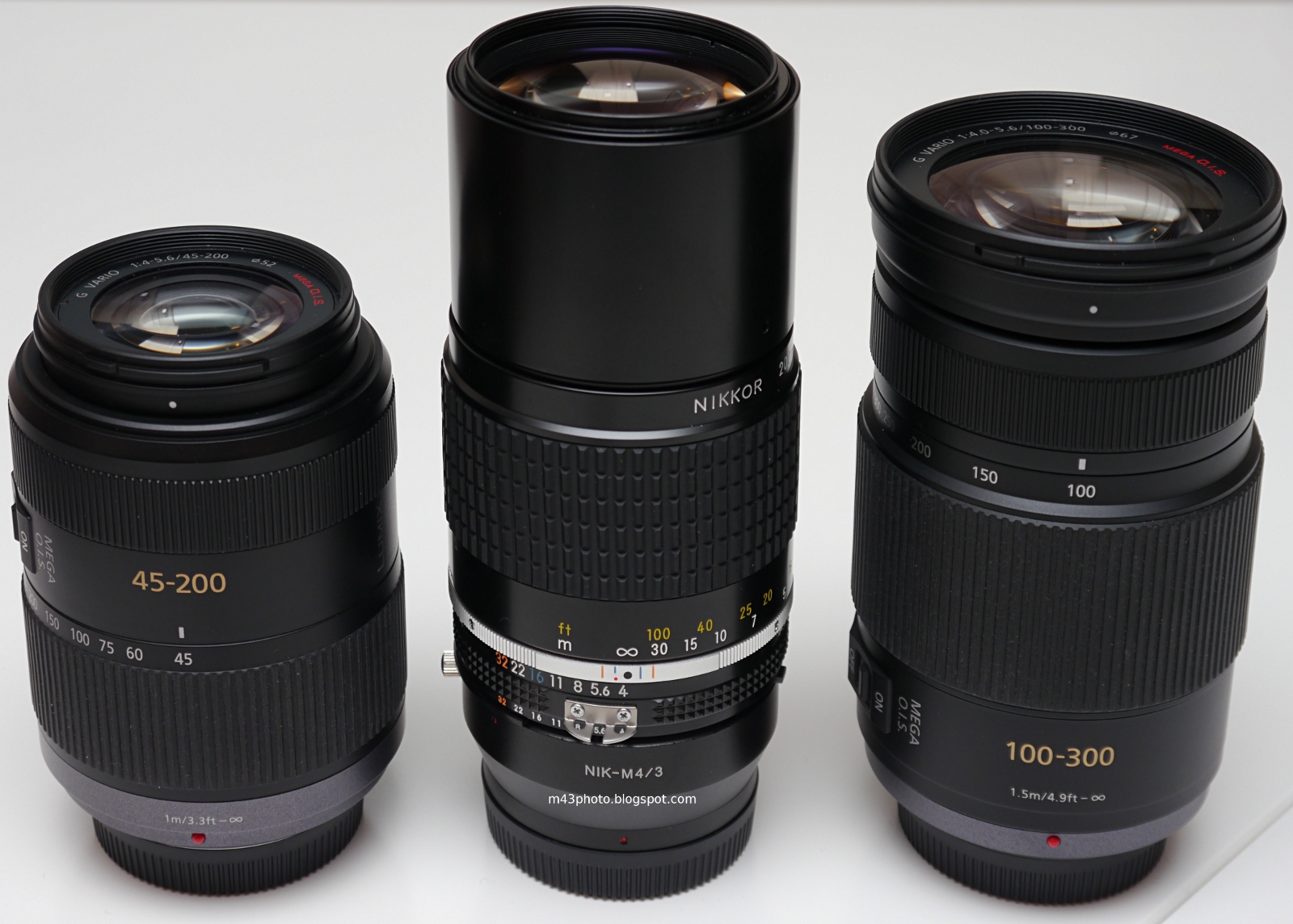
I decided to test the bokeh with some out of focus highlights. To do this, I photographed the same subject using three lenses, the Panasonic Lumix G 100-300mm f/4-5.6, Nikkor 200mm f/4 AIS, and Panasonic Lumix G 45-200mm f/4-5.6. The three lenses are shown below:


The Nikkor 200mm f/4 AIS lens in the centre is shown including the adapter needed to connect it to a Micro Four Thirds camera.

@ 200mm

The images were taken at dusk, with the camera on a sturdy tripod, and focused on the tree about 2 meters from the camera. I used ISO 160, the base ISO for the Panasonic GH2 camera. As I took the images late dusk, the lightning changed quickly, and they may have different exposure.

Here are the images, click to enlarge:


Lumix G 45-200mm @ 200mm f/5.6

Nikkor 200mm f/4

Lumix G 100-300mm @ 200mm f/4.9

I have made some enlargements as well. These are 100% crops from the centre of the images.


Bokeh

Based on this study, I cannot see any problems with the bokeh of these lenses. They all look just fine. One problem with the Nikkor 200mm f/4 AIS lens, though, is that the aperture diaphragm blades are not rounded. Hence, when stopping down, the lens gives nine-sided out of focus discs, they don't have a rounded edge:


Sharpness

When it comes to the sharpness, the crops above are not suited for comparing the sharpness across the lenses. The Lumix lenses support autofocus, of course, and after viewing the images on PC, I noticed that the camera has prioritized to get the edge of the tree in focus. When focusing the Nikkor 200mm lens manually, I focused on the centre of the branch. So they are not comparable. However, after looking at the images, my conclusion is the same as before: The Panasonic Lumix G 100-300mm f/4-5.6 is significantly sharper than the Panasonic Lumix G 45-200mm f/4-5.6 at 200mm. The Nikkor 200mm f/4 lens appears to sit between them, in terms of sharpness.

@ 300mm

The Panasonic Lumix G 100-300mm f/4-5.6 is my only lens capable of doing 300mm focal length. So I don't have anything to compare with. But here are a couple of images taken at 300mm f/5.6 and f/8:


Again, the bokeh looks just fine, no perceived problems here.

Conclusion

While I believe the Panasonic Lumix G 100-300mm f/4-5.6 is prone to giving slightly distracting bokeh in certain cases, I could not reveal any in this simple test.

We see clearly that the Nikkor 200mm f/4 AIS lens has non-circular out of focus rendering when stopped down, due to non-rounded aperture diaphragm blades. This is not so good for the resulting pictures.

I think that this simple test illustrates another example that legacy lenses are not perfect for use on modern cameras. While the lens is reasonably good in terms of sharpness, the primitive aperture makes it problematic when stopped down. In a previous study, I saw that the Pentax FA50 f/1.4 normal lens exhibits quite distracting bokeh between f/1.4 and f/2. The whole point of getting a fast legacy normal lens is to use it pretty much wide open, and that example shows that it can be non-optimal for such use.

So take care if you buy older manual lenses for use on Micro Four Thirds: Do some pre purchase research to make sure the lens fits your needs.

Wednesday, 5 October 2011

Sharpness comparisons @ 100mm and 200mm

Panasonic has got several Micro Four Thirds lenses that span the tele focus range, with the Lumix G 45-200mm f/4-5.6, Lumix G HD 14-140mm f/4-5.8, and Lumix G 100-300mm f/4-5.6 being three of them. The last one is the recently announced powerzoom capable Lumix X PZ 45-175mm f/4-5.6.

The Lumix G 45-200mm f/4-5.6 is a value tele zoom lens, with a useful focus range reaching from the typical portait to long tele area. It gives a good value for money for those who want to try out the tele range.

Marketed as a video optimized lens, the Lumix G HD 14-140mm f/4-5.8 is in fact versatile superzoom lens for photo and video use alike. It is large, expensive, and generally regarded as being very good.

The largest of the three, the Lumix G 100-300mm f/4-5.6, is a very long tele zoom, useful for various event photography, like spectator sports, birdwatching, safari, and so on. For this use, the price is in fact rather reasonable.

The three lenses are seen below:


But how do their sharpness compare? To try to answer this, I've tried to compare them where they overlap. In this experiment, I put the camera on a sturdy tripod, shot at ISO 160 with the Panasonic GH2, and used a delayed shutter to avoid camera shake. I also turned off OIS. I set the white balance to "overcast" for all the images.

I left the exposure at auto at all time, and sadly, the exposure turned out to be slightly different for some of the images. That's a bit negative for this comparison, but I think we can live with it.

Sharpness at 100mm

Here are the full images shot at 100mm, scaled down and sharpened. Click for larger images.


Lumix 45-200 @ 100mm f/4.7Lumix 100-300 @ 100mm f/4Lumix 14-140mm @ 100mm f/5.8

To better compare the sharpness, let's look at 100% crops. I have not applied any sharpening to these 1:1 images. These are taken from the image center. Click for larger images.

As it was a bit windy, I recommend that you don't look at the leaves to evaluate the sharpness. They may be negatively affected by motion blur due to the wind.


Sharpness at 200mm

Here are the full images shot at 200mm, scaled down and sharpened. Click for larger images.


Lumix 45-200 @ 200mm f/5.6Lumix 100-300 @ 200mm f/4.9

To better compare the sharpness, let's look at 100% crops. I have not applied any sharpening to these 1:1 images. These are taken from the image center. Click for larger images.


And from the top right corner:


Conclusion

Based on this study, it is quite clear that the Lumix G 100-300mm f/4-5.6 is the sharpest of the three lenses. It appears to be quite sharp even wide open. On the other hand, one could say that this is not surprising: It was used in the shorter end in this study, compared with the Lumix G 45-200mm f/4-5.6 which was used in the longer end of its zoom range. Also, the Lumix G 100-300mm lens has the lowest zoom ratio, which allows the designers to make less compromises.

The Lumix G HD 14-140mm f/4-5.8 disappoints a bit. But then again, it is a well known fact that it is not at its sharpest in the longer end, and 100mm is surely a long focal length for this lens.

The bokeh appears to be comparable between the 45-200mm lens and the 100-300mm lens. Perhaps one could say that the Lumix G 45-200mm is slightly more busy with the longer of these lenses, with some more "ringing" around the out of focus highlights. But they are pretty similar.

Monday, 3 October 2011

Lumix G 100-300mm f/4-5.6

The Panasonic Lumix G 100-300mm f/4-5.6 Mega O.I.S. is a long tele zoom. This kind of lens would normally be used by people who are interested in photographing birds, wildlife, spectator sports, safaris, and so on.


More mature DSLR camera systems are, generally speaking, better suited for these applications. This is due to a better continuous autofocus, which is possible with the PDAF system used in DSLR cameras. Hence, people with these interests, are probably using Canon and Nikon cameras, rather than Micro Four Thirds. However, with the introduction of the Lumix G 100-300mm, M4/3 users have a possibility to check this out.

Tuesday, 20 September 2011

Lens buyer's guide

So, you have a Micro Four Thirds camera? Now, what lenses should you buy?

Before trying to answer this question, let's take a step back and ask: Why would you need more lenses?

Compact cameras and interchangeable lens cameras

A user coming from the compact camera world may be confused by the apparent need for more lenses. Even fairly inexpensive compact cameras comprise a feature packed lens: A zoom range of 12x or more, starting at a very wide angle, macro functionality, and even pretty decent maximum aperture (a low f-value). All this in a small package.

When "upgrading" to a Micro Four Thirds camera with the kit lens, they may easily be disappointed. They now have a larger, more expensive camera, which only features a 3x zoom lens, starting at 28mm equivalent wide angle, and no macro functionality. How is this an upgrade at all?

The answer to this lies in the size of the imaging sensor. Compact cameras generally have a very small sensor, which allows the manufacturer to design very small lenses that have all the functionality most people would want. With a larger sensor, it is physically impossible to design a lens which does the same, at least within reasonable economical constraints.

This picture illustrates the relative size of sensors. The Four Thirds sensor (red) is one quarter the size of the classic 135 negative film (black), but still a lot larger than the sensor in mobile phones and basic compact cameras (orange):


So why don't all cameras have small sensors, so that the built-in lens can solve all the photographic needs of the user?

Thursday, 8 September 2011

Noise comparison, aperture change

I have previously compared the focus noise of various lenses. The conclusions from my analysis were hardly surprising, for example, the Lumix G 20mm f/1.7 pancake lens had a rather loud focus noise, due to the traditional focus assembly which moves all the lens groups back and forth.

The lenses with an internal focus mechanism generally featured lower noise, with the Panasonic Leica Lumix DG Macro-Elmarit 45mm f/2.8 1:1 Macro and Lumix G HD 14-140mm f/4-5.8 as exceptions. In the latter case, I believe the microphone was too close to the lens, giving biased results.

You could ask why worry about the aperture change noise. After all, the aperture is generally stopped down just before the shutter is released. And for all Micro Four Thirds cameras, the shutter noise is rather high. So the aperture noise is simply drowned by the shutter noise anyway.

However, there are times when you don't trigger the shutter. This could be when using the new high speed, low resolution mode of the Panasonic GH2. Or, quite simply, when recording videos.

Also, some time in the future, we are going to get cameras without mechanical shutters. When the global shutter technology is mature enough, we will see this in Micro Four Thirds cameras. Then, the only noise we will hear is the focus noise and aperture noise.

To measure the aperture change noise, I placed a mobile phone near the camera, running the "Decibel Ultra" app, to measure the noise level. While I don't trust the absolute measurement of the phone, I think it is good enough to look at the relative levels of noise.

The GH2, and many other Micro Four Thirds cameras, has the feature of stopping down the aperture to preview the depth of focus (DOF). This is very useful, especially for macro photography. I use this feature to toggle the aperture between maximum and f/7.1.

The test


Results

I have only noted down the peak decibel measurements. The results:

LensMeasurementsAverage

Lumix G 8mm fisheye
77 76 7777 dB
Lumix G 14mm79 7778 dB
Lumix G 20mm76 75 73 7675 dB
Leica Lumix DG 45mm macro80 82 81 8382 dB
Lumix G 45-20083 80 81 84 8382 dB
Lumix G 14-4275 76 75 7575 dB
Lumix G HD 14-14078 78 8179 dB

Conclusions

According to the marketing material, the HD designation of the Lumix G HD 14-140mm f/4-5.8 superzoom lens means that it should have fast autofocus, low noise autofocus, and near stepless low noise aperture.

After my analysis of the AF speed, the AF noise and now, the aperture noise, I cannot see that the lens is that special. It performs pretty much like the basic kit lens. What I haven't looked at, though is the aperture change, which is quoted as "near stepless". Accurate to 1/6 stop, is what I have seen quoted.

That said, the Lumix G HD 14-140mm f/4-5.8 zoom lens does have a softer sound when changing aperture.

In terms of aperture noise, the lenses appear to perform quite similar. And this is not strange: The aperture diaphragm mechanisms are probably rather similar between the lenses.